Mycroft Review (2026)A Feature List With the Prices Removed
 By Daan Haket · Researched and written with an AI assistant · who does what
The pricing page is a feature list with the prices taken out, and that is a choice rather than an oversight — Mycroft publishes what is in each package down to the individual capability, then stops short of the one line you came for.
companies chasing an attestation they cannot staff for — CMMC or FedRAMP to keep bidding on defence and public-sector work, SOC 2 or ISO 27001 to get through enterprise procurement — that would rather buy the platform, the security stack and the people who operate it on one contract than assemble a GRC tool, a pen tester, a vCISO and a monitoring vendor separately and hold them together themselves.
you already have a security team and only need the evidence-collection and control-monitoring layer, because the managed half is most of what you would be paying for; or you need to compare cost before capability, because nothing here is priced anywhere and every tier ends in a sales conversation.
Transparency: the “Visit” links on this page are affiliate links — we may earn a commission if you sign up, at no extra cost to you. No vendor can pay for a better review or verdict. How we make money →
Pricing (2026)
✓ Pricing re-verified 11 Oct 2026
| Plan | Price | What you get |
|---|---|---|
| Platform | no published price | Full GRC platform for SOC 2, ISO 27001, GDPR, HIPAA; CNAPP; security/AI/privacy training; 24/7 monitoring; Trust Center; basic Agentic AI workflows |
| Scale | no published price | Adds penetration testing, continuous third-party risk management, customer success manager, expanded AI workflows |
| Managed | no published price | Adds customised frameworks, customised AI workflows, dedicated CISO as success manager |
Summarised from the pricing notes below; the notes carry the conditions.
Mycroft has no public pricing: three packages, and not one number between them. Platform is the entry tier and the only one whose button says Get started rather than something sales-shaped; it bundles the full GRC platform for SOC 2, ISO 27001, GDPR, HIPAA and more, a Cloud Native Application Protection Platform, security, AI and privacy awareness training, 24/7/365 threat intelligence and monitoring, a Trust Center, and what Mycroft calls basic Agentic AI workflows.
Scale says Book a demo and adds penetration testing, continuous third-party risk management, a customer success manager and expanded AI workflows. Managed says Talk to sales and adds customised frameworks, customised AI workflows and a dedicated CISO who doubles as your success manager. What the page never does is price any of it: no monthly figure, no per-seat rate, no starting-from, no annual floor, not even for the tier you are invited to start by yourself.
Full pricing notes (2 more paragraphs)
We looked past the pricing page before writing that down, because the claim is usually wrong. The FAQ page, the product pages, the CMMC-as-a-Service page and the machine-readable llms.txt all describe the packages in detail and none of them names an amount; the sitemap holds no second pricing page; and the raw HTML of /pricing carries no hidden figure either. So the tiers tell you exactly what you get and leave what you pay entirely to a call.
Checked again 11 October 2026 on www.mycroft.io/pricing and www.mycroft.io/llms.txt: the same three packages with the same contents, and still no amount anywhere.
Plans change — always verify the live price on their site.
Vendor-confirmed: Confirmed in writing by Eric Yanofsky, Mycroft via PartnerStack, 30 Sep 2026. Not tested by us at a checkout.
The honest knock
It matters more here than it would elsewhere, because what Mycroft sells is not a seat of software: it is a platform bundled with a managed service, secure enclaves, infrastructure and identity management, an audit coordinated on your behalf and, at the top, a dedicated CISO. That is a services contract, and services contracts scope on your environment, so the number genuinely will differ per company. It also means you cannot sanity-check the cost against doing it yourself until you have sat through a demo.
The second thing to weigh is how much of the evidence is the vendor talking. What you can verify from outside is a handful of named case studies — SmashSend, Weave, Wisedocs, Unified — and the quotes inside them; there is no published customer count and no independent review base to read. The team is not thin: the CEO holds a CISA, the engineering co-founder a CISSP, and the product co-founder co-founded PartnerStack.
But a young company promising CMMC and FedRAMP outcomes is asking for trust on a timeline where being wrong is expensive. Ask what happens if the assessment does not pass, and ask it before the second call.
Watch the video review
The video version of this review, from our YouTube channel.
What Mycroft does
Security and compliance platform plus managed service for companies without a security department: a GRC platform mapped to CMMC, FedRAMP, SOC 2, ISO 27001, HIPAA and GDPR, bundled with cloud and application security, device management, third-party risk and awareness training, and backed by a Risk Operations Center staffed by its own experts around the clock. 150+ native integrations across AWS, Azure, GCP and the major code hosts. Three packages — Platform, Scale, Managed — and none of them is publicly priced. Mycroft Technologies Inc.; not the Mycroft AI voice assistant.
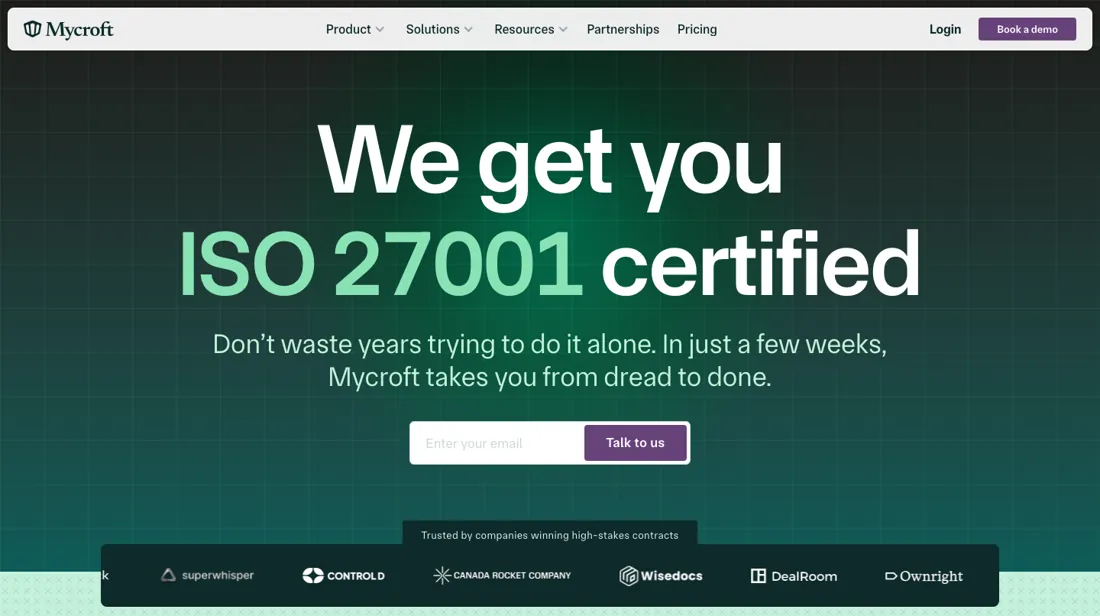
What actually decides your tier
The ladder does not buy more software; it buys more people. The GRC platform covering SOC 2, ISO 27001, GDPR and HIPAA, the Cloud Native Application Protection Platform, the awareness training, the 24/7/365 threat intelligence and monitoring and the Trust Center all sit on Platform, the entry tier. Scale adds penetration testing, continuous third-party risk management and a customer success manager. Managed adds customised frameworks and a dedicated CISO. So the question is not which features you need but how much of the work you intend to do yourself — and if you have the engineers and want only the evidence layer, the entry tier already holds it.
What moving up does not fix is the part that makes this hard to budget for. No tier carries a price, not even the one whose button says Get started, so choosing a higher package does not shorten the sales conversation. Nor does it settle what sits outside the contract: audit fees, enclave infrastructure and what happens when an assessment does not pass first time are unpriced on every tier. Those answers come from the call, not from the package you pick.
Questions we are still checking
Facts about Mycroft that would change a buying decision, and where we stand on each. An unanswered question does not mean the feature is missing; it means we have not confirmed it yet.
- Is the external auditor or CMMC assessor fee inside the Mycroft price? Still checking
Applies to: Platform, Scale, Managed; SOC 2, ISO 27001, CMMC.
Why it matters: the audit itself can be a large share of first-year cost, and the site describes preparing for it, not paying for it.
Checked: Mycroft FAQs (2026-10-11); Mycroft CMMC as a Service (2026-10-11)
Have a public source that answers one of these? How we review explains how we check and correct.
How to actually use Mycroft
Do two things before the demo, because they decide the whole conversation. First, write down which framework the contract actually requires and by when — CMMC, FedRAMP, SOC 2, ISO 27001 — since the scope of your compliance boundary, not your headcount, is what Mycroft prices against. Second, price the alternative honestly on paper: a GRC subscription, a pen test, an auditor and whatever fraction of a security engineer or vCISO you would need, over the same twelve months.
You will not be able to do that comparison during the call, because Mycroft brings the only number and you bring none. Then ask three things on the call and get the answers in writing: what the figure is for your scope, what sits outside it (audit fees and enclave infrastructure especially), and what happens if the assessment does not pass first time. None of that is published anywhere on the site, which is exactly why it is worth asking rather than assuming.
Distilled from Mycroft's own pricing page (www.mycroft.io/pricing) together with its FAQ, product pages, the CMMC-as-a-Service page and the machine-readable llms.txt, read 4 September 2026 — the three packages and what each one contains, and the confirmed absence of any published amount across all of them. Checked again 11 October 2026 on www.mycroft.io/pricing, www.mycroft.io/llms.txt, www.mycroft.io/faqs and www.mycroft.io/cmmc-as-a-service, all read 11 October 2026.
The natural comparison is a self-serve compliance-automation platform — the honest comparison is not feature against feature but model against model. Tools like Vanta, Drata or Secureframe sell you the software that watches your controls and collects the evidence — you still supply the people who fix what it finds, and you still hire the pen tester and the auditor separately. Mycroft sells the software with the people attached: the Risk Operations Center, the remediation, the enclaves, the audit coordination and, on the top tier, a named CISO. If you have the engineers and only want the paperwork automated, the self-serve platform is the cheaper shape and its price is easier to find. Mycroft earns its place when the gap is expertise rather than tooling, and when CMMC or FedRAMP — the frameworks it leads with, and the ones where a generic SOC 2 tool helps least — is what stands between you and the contract.
Frequently asked questions
Does Mycroft run the audit, or prepare me for one?
It prepares you. Mycroft's FAQ (read 11 October 2026) says it maintains audit-ready documentation, gathers evidence continuously and 'generates auditor exports'; its CMMC page (read the same day) promises 'assessor-ready documentation' and says the setup covers about a third of the required controls. Neither page says Mycroft performs the attestation or that the auditor's or assessor's fee is in the price: not confirmed, so ask for it in writing in the quote.
Is penetration testing included?
Only from Scale up. The pricing page (read 11 October 2026) lists penetration testing in Scale and Managed, not in Platform. The FAQ says bundling a pen test with Mycroft is 'faster, often cheaper', but no price is published for the test or for any package, and how many tests a year Scale includes is not stated: not confirmed.
Is this a hands-on review of Mycroft?
This is a researched assessment, not a hands-on test — where we've used a tool ourselves, we say so explicitly. We name what each tool is good and bad at, and we earn a commission only if you sign up, at no cost to you.
- Read 4 September 2026 on www.mycroft.io/pricing.
Others in this category
Reviewed security tools that share ground with Mycroft — comparable in what they do, not drop-in swaps:
New reviews, price changes we recorded, and the cost conditions we found. No sponsored placements. Unsubscribe anytime.
This is our researched assessment — not a paid placement. The “Visit” links on this page are affiliate links: we may earn a commission if you sign up, at no extra cost to you, and it never changes our take. How we review →