 Digit Review (2026)
The tier price is a floor, not a ceiling, and the add-ons are where an inventory system quietly doubles.
Visit Digit → Affiliate link — the rest of this page is the honest version, including who should skip it.
Watch the 2-minute review
Same honest take, in video form — from our YouTube channel.
Pricing (2026)
✓ Pricing re-verified 5 Sep 2026
| This tool | $400 | 14th cheapest of 16 |
| Cheapest | $8.33 | QuillBot |
| Median | $45 | |
| Most expensive | $699 | Wing Assistant |
Entry price per month, USD. Our own dated readings of 16 operations & workflow tools — not a market survey, and cheapest is not best.
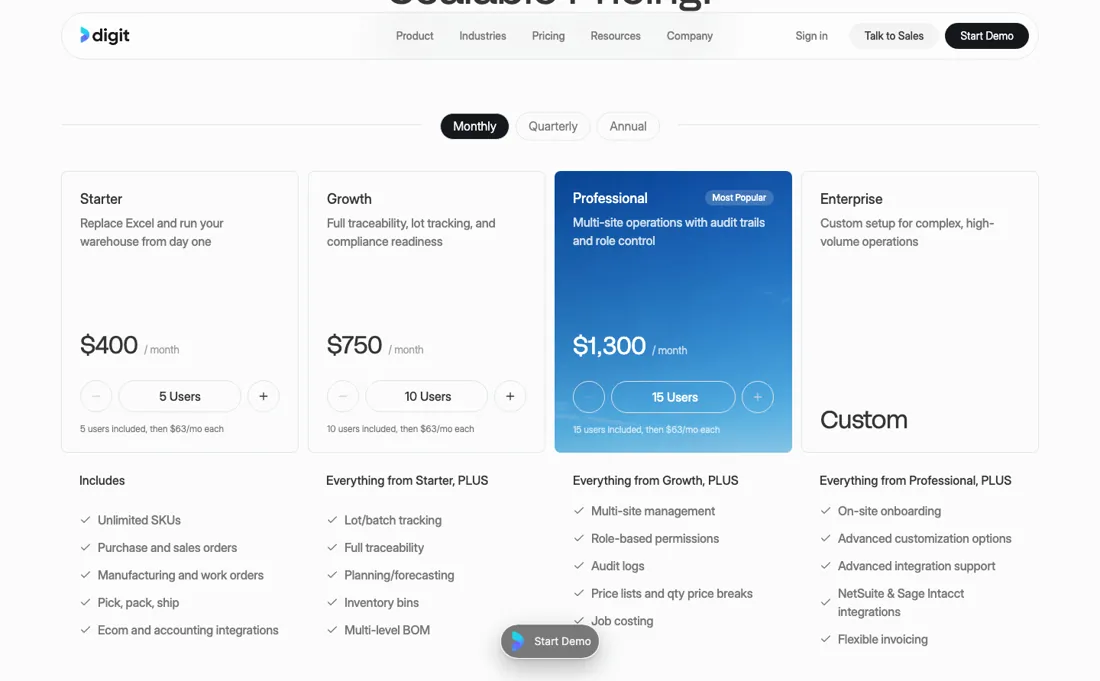
Four tiers with three published: Starter $400/month including 5 users, Growth $750 including 10, Professional $1,300 including 15, and Enterprise on quote. Extra users are $63/month each on every tier. Paying quarterly takes 10% off — $360, $675 and $1,170 a month, shown with the quarter total beside it — and annually 20%, which is $320, $600 and $1,040 with the year total beside it; the page now opens on Monthly, so the first figure you see is the real monthly rate.
Two integrations are included on every plan. The third and each one after it is where the page disagrees with itself: the Integrations block says $100 a month, the FAQ on the same page says $125, and the add-on cards side with the FAQ — API access $125 a month, MCP access $125, push notifications and webhooks $63, all the same price on Starter, Growth and Professional.
Customer portals are $18.75 per portal per month on every tier, Enterprise included. We have asked Digit which integration price is the one they bill. Plans change — always verify the live price on their site.
What the pricing page doesn’t say
Two integrations are included — but a working setup usually means an accounting package and a webshop, which is your two, and then Amazon or a second sales channel is another $125 a month by the FAQ (the integrations block on the same page still says $100; we have asked which one bills). Want the API, or your data inside an AI assistant? $125 a month each. A Starter customer on QuickBooks, Shopify and Amazon with API access is at $650 a month on the FAQ's numbers, $625 on the block's, before adding a sixth user. Price the whole configuration you actually need, not the tier.
What Digit does
Inventory, production, purchasing and sales in one system for manufacturers and distributors. Starter $400/month with 5 users, Growth $750, Professional $1,300, extra users $63 each. Watch the add-ons: a third integration is $100 to $125 a month, and API or MCP access is $125 each.
What buyers report about Digit
Recurring themes from the buyer-review sites listed at the foot of this page, read in August 2026. We have not run Digit ourselves, so this is other buyers' experience rather than ours. We summarise it here because the complaints are usually the part a vendor page leaves out.
- • The switch off spreadsheets is the thing reviewers actually credit. A machinery-industry reviewer describes moving from taped-together spreadsheets to a system that answers back, and a packaging manufacturer says inventory visibility across production was the problem that stopped being a problem.
- • Implementation comes up more than features. Reviewers from machinery and logistics describe onboarding as supported rather than dumped, with training short enough that staff picked it up without a project team behind them.
- • Several reviewers say the vendor built around them: when the platform did not cover a specific need, the team worked out an interim solution rather than closing the ticket. A COO also calls the interface fast and the price competitive against what he compared it with.
- • The manufacturing depth is thinner than the marketing suggests. A plastics reviewer names lot number generation and label traceability as missing — which matters, because traceability is exactly the reason a manufacturer chooses this category over a warehouse module.
- • Integrations are the second recurring ask: reviewers want more connections to the rest of the business, and a furniture manufacturer describes the manufacturing customisation as still early-stage.
- • Getting started is data entry. A food and beverage reviewer warns of a good amount of raw data entry to build bills of materials before the system earns anything — budget that as a project, not an afternoon.
Where the ratings disagree. Read the shape of this record before you read the score. Twenty reviews, nineteen of them five stars and one four — a distribution that in practice means the vendor collected reviews from customers it already knew were happy, not that nobody has had a bad month. The single four-star review is also the only one that names a hard limit (lot numbers, label traceability), which makes it the most informative entry in the set. There is no G2 or TrustRadius presence to cross-check against, so ask Digit for two references in your own industry who have run a full year, and ask them specifically about traceability and about the second and third integration.
When the paid plan is worth it
Run the per-seat arithmetic before you upgrade, because the middle tier is the best value and the tier above it is worse per person. Starter is $400 for 5 users ($80 each), Growth is $750 for 10 ($75 each), Professional is $1,300 for 15 ($86.67 each). The ladder does not get cheaper as you climb -- it dips at Growth and rises again. That opens a gap worth real money, because extra users cost $63 a month on every tier.
Fifteen people on Growth plus five extra seats is $750 plus $315, or $1,065. The same fifteen people on Professional is $1,300. Staying on Growth saves $235 every month for identical headcount -- $2,820 a year. One thing to check before acting on it: the pricing page lists what each tier includes in users but does not spell out which features Professional adds, so ask what you would give up before you decline the upgrade.
The integrations are where the bill quietly grows. Two are included; every one after that is $125 a month by the FAQ and the add-on cards, or $100 by the integrations block on the same page, and API access and MCP access are $125 a month each on top, webhooks $63. Four extra integrations plus API access is therefore $625 a month on the FAQ's figure ($525 on the block's), which is more than the entire Starter plan either way.
Paying quarterly takes 10% off and annually 20%, so settle your integration list before you commit to a year.
How to actually use Digit
Onboarding is a data-migration job with an agent bolted on top. Digit's Onboarding Agent reads a spreadsheet, maps its columns to Digit fields, makes bulk edits and flags the fields it is unsure about for you to review and confirm. Records can also arrive through native integrations: QuickBooks Online and Desktop, NetSuite, Xero and Sage Intacct on the accounting side, and Shopify, WooCommerce, Amazon and eBay for sales channels. Alongside that sits a dedicated onboarding specialist who configures workflows, migrates data and trains the team, and Digit says it treats a system as live only once software and hardware are both running.
Take your timing from their FAQ rather than the banner above it: the page promises onboarding in 30 minutes and quotes a customer fully live in under 30 days, while the FAQ puts most businesses live in two to six weeks. The same FAQ adds that implementation is scoped by complexity and may carry a one-time onboarding fee for advanced deployments. Day-to-day guides sit at learn.digit-software.com. One capability postdates that reading.
Digit announced Digit Studio in its partner newsletter of 27 August 2026: a natural-language builder for custom reports, workflows and dashboards inside Digit itself, meant to be changed by the person who uses it rather than by a consultant. That is a vendor announcement, not something we have run, and the pricing page we read on 15 August 2026 does not list it — so do not assume your tier includes it.
The name is changing too. Digit told partners on 11 September 2026 that it is rebranding to Sutton — same team, same company, and partner terms, contact and revenue share all unchanged — with the new name and logo reaching its site and materials "in the coming weeks". No date was given, and when we checked digit-software.com on 11 September the site still read Digit throughout, so this is an announcement rather than something you will see yet.
Expect the product you sign up to under one name to carry the other before long.
Distilled from Digit's own Rapid Onboarding page (https://www.digit-software.com/resources/onboarding), including its FAQ block, and the Digit Learning Center (https://learn.digit-software.com/en/), both fetched and hashed 19 August 2026. The integration list was re-read on Digit's own integrations page (https://www.digit-software.com/integrations) on 27 August 2026. Digit Studio comes from Digit's own partner newsletter of 27 August 2026 and is reported as a vendor announcement, not a hands-on reading.
The natural comparison is Katana — the natural head-to-head for manufacturers leaving spreadsheets. Both cover inventory and production; the difference shows up in how they charge for the edges. Price the full configuration you need on each — every integration, the API if you want it — because Digit's per-connection add-ons — $100 to $125 a month for each integration past the first two, and $125 for API or MCP access — are where the tier price stops being the price.
More on Digit
Everything we publish about Digit links back here — the review stays the honest hub:
The ex-banker filter — the same yardstick on every review (how we review): My ex-banker filter is simple: does Digit remove a real cost — time, errors, missed revenue — bigger than what it charges?
Frequently asked questions
What should I weigh before buying Operations & Workflow software?
Usually it sits on top rather than replacing everything. Tools in this class tend to become the layer where work is tracked and handed off, while your existing systems stay the source of truth for their own data. Before you buy, map which tools it would replace outright and which it would merely sync with. If the answer is that it syncs with all of them, you are adding a layer rather than removing one.
Is this a hands-on review of Digit?
This is a researched assessment, not a hands-on test — where we've used a tool ourselves, we say so explicitly. We name what each tool is genuinely good and bad at, and we earn a commission only if you sign up, at no cost to you.
- Buyer reviews on Software Advice and GetApp (the same Gartner review pool), read August 2026.
- Re-read 2026-09-05 in a rendered browser on their own pricing page.
- A dated screenshot of that pricing page, kept on this site as the receipt.
Others in this category
Reviewed operations & workflow tools that share ground with Digit — comparable in what they do, not drop-in swaps:
New dossiers, cost-traps we found, and tools that earned a keep — no hype, no sponsored-disguised-as-advice. Unsubscribe anytime.
This is our researched assessment — not a paid placement. The “Visit” links on this page are affiliate links: we may earn a commission if you sign up, at no extra cost to you, and it never changes our take. How we review →