 Credit Repair Cloud Review (2026)$49 Solo, $179 for Client Work
This is business-in-a-box software for starting a credit-repair company, not a tool that repairs your own credit — the price only makes sense if you're actually building a client business on it.
Visit Credit Repair Cloud → Affiliate link — the rest of this page is the honest version, including who should skip it.
Watch the 2-minute review
Same honest take, in video form — from our YouTube channel.
⚡ Short on time? Watch the 30-second verdict Short.
Pricing (2026)
✓ Pricing re-verified 21 Aug 2026
There are five plans, priced monthly. Personal is $49 for 1 user and up to 3 friends and family, and Start $179 for up to 3 users and 300 active clients. Grow is $299 for 6 users and 600 clients, and Scale $399 for 12 users and 1,200 clients. Enterprise is $599 for 24 users and 2,400 clients. Annual billing takes 20% off and is shown as a monthly equivalent on the four business tiers: $143.20, $239.20, $319.20 and $479.20.
Every plan carries a 30-day free trial, the vendor states it charges no startup fees, and monthly plans have no long-term contract while annual plans require a one-year term. Plans change — always verify the live price on their site.
What the pricing page doesn’t say
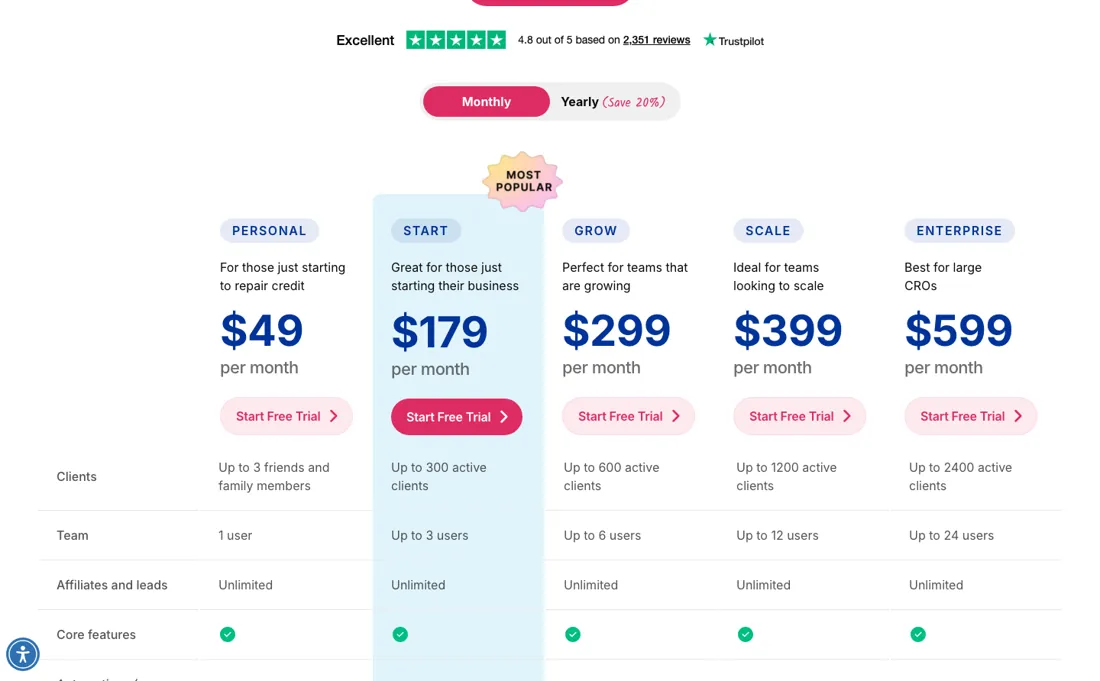
The middle tiers jump fast as you add clients and seats, and success depends far more on your sales and compliance discipline (credit repair is a regulated space) than on the software. Buy it as an operator, not a consumer.
What Credit Repair Cloud does
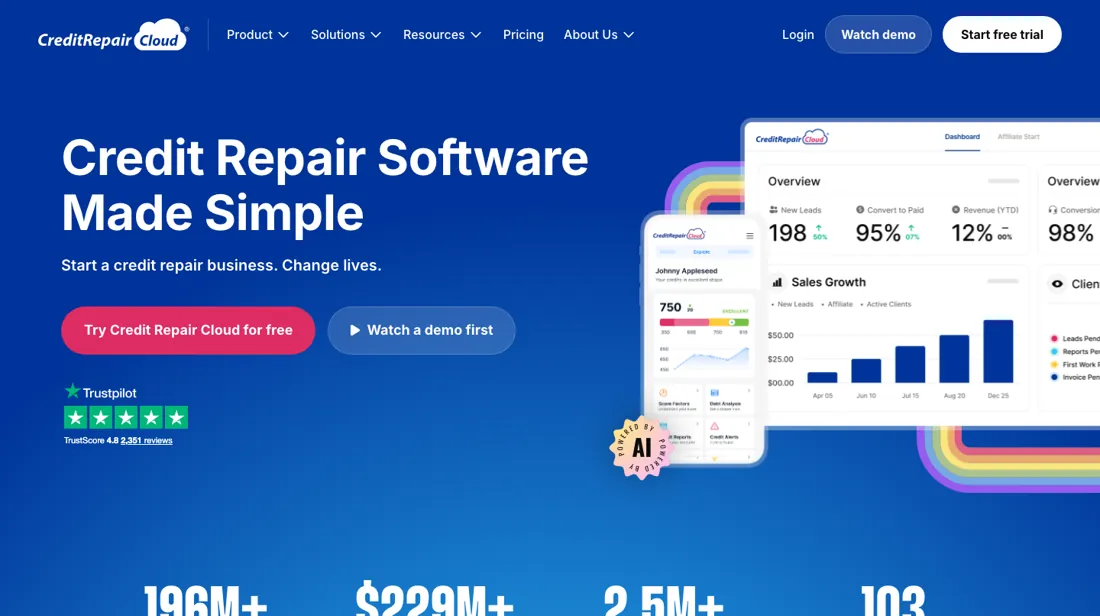
Software for running a credit-repair business: client management, dispute automation and letter workflows. It is not a tool for repairing your own credit. Plans run from about $49/month (Personal) to $599 (Enterprise), scaling by active clients and seats.
What buyers report about Credit Repair Cloud
Recurring themes from the buyer-review sites listed at the foot of this page, read in August 2026. We have not run Credit Repair Cloud ourselves, so this is other buyers' experience rather than ours. We summarise it here because the complaints are usually the part a vendor page leaves out.
- • 2,346 Trustpilot reviewers, with positive comments on service quality and support, and it remains the best-known software for running a credit repair business.
- • Flat-rate pricing with no per-client fee is genuinely unusual in this category.
- • An F rating at the BBB, for failing to respond to four of seven complaints. Not BBB-accredited.
- • Complaints describe false representations about service outcomes, data import failures that disrupted customers' own client work, and unresponsive support on refunds.
- • The CFPB reached an agreement with Credit Repair Cloud over allegations that it helped other credit repair businesses charge consumers illegal fees. If you plan to build a business on this, that regulatory history is your context too, not just theirs.
Where the ratings disagree. Trustpilot is broadly positive while the BBB rating is an F and a regulator has acted. Those describe different things: the software experience on one side, the company's conduct and the legal frame around the industry on the other. Read both.
When the paid plan is worth it
The ladder, re-verified against the vendor's pricing page: Personal $49, Start $179, Grow $299, Scale $399, Enterprise $599. Tiers scale on active clients and seats - 3 friends and family on Personal, then 300, 600, 1,200 and 2,400 clients, and 1, 3, 6, 12 and 24 users. The striking thing is where the jump sits. Personal to Start is roughly three and a half times the price -- by far the largest step on the ladder -- while every step above it is a much gentler climb.
That shape usually means Personal is a starter-for-one rather than a small version of the business product, so the question to settle is not which tier fits your budget but whether you are running this as a business at all. If you are, the real entry price is the $179 one. Two things work in your favour while you decide. The trial is 30 days, which is long enough to take on real clients and see what the workload actually is, and there is no contract, so a wrong tier is a month of waste rather than a year. Annual billing takes roughly 20% off once you know which tier you belong in.
Our monthly capture read this vendor's pricing page in July 2026 and again in August 2026, and the amounts were the same both times. We keep watching — the registry records what moves.
How to actually use Credit Repair Cloud
The vendor's Getting Started Guide runs in six parts: the business workflow, create a client, import the credit report, then the Dispute Wizard. The import step carries the preparation, because the client rather than you must order the monitoring. Credit Repair Cloud imports from Credit Hero Score (its own recommended provider), IdentityIQ, SmartCredit, MyFreeScoreNow, MyScoreIQ and PrivacyGuard. You pull the report from the client's profile under Import/Audit, entering that client's provider username and password.
One choice is effectively permanent: the documentation states that moving a client to a different provider means creating a new client profile, because the data structures differ. Settle the provider before onboarding. In the Dispute Wizard every new client starts at Round 1: Basic Dispute - Credit Bureaus, capped at five items per selection, with unchecked items held as Pending. The vendor recommends 3 to 5 items per bureau within 30 days to avoid being treated as frivolous, and attachments must be PDF, JPEG or PNG under 10 MB. Round 2 and higher letters come from Letter Finder, which trial accounts cannot open.
Distilled from Credit Repair Cloud help centre: the six-part Getting Started Guide, "Part 3: Importing Credit Reports" and "Part 4: Introduction to our Dispute Wizard Tool", read 21 August 2026.
The natural comparison is Dispute Fox or Client Dispute Manager — comparable credit-repair business platforms — compare on client limits and automation depth at your stage.
More on Credit Repair Cloud
Everything we publish about Credit Repair Cloud links back here — the review stays the honest hub:
The ex-banker filter — the same yardstick on every review (how we review): My ex-banker filter is simple: does Credit Repair Cloud remove a real cost — time, errors, missed revenue — bigger than what it charges?
Frequently asked questions
What should I weigh before buying Financial Operations software?
The bar here is higher than features. Check who actually holds the money and under what licence, whether client funds are segregated, what audit trail and permission controls you get, and how support behaves when something goes wrong mid-transaction. Anything touching payments should be able to answer those in writing; if it cannot, that is your answer.
Is this a hands-on review of Credit Repair Cloud?
This is a researched assessment, not a hands-on test — where we've used a tool ourselves, we say so explicitly. We name what each tool is genuinely good and bad at, and we earn a commission only if you sign up, at no cost to you.
- Buyer reviews on the BBB, Trustpilot and CFPB filings, read August 2026.
- Price re-verified 2026-08-21 against the vendor's own pricing page, and now with the published limits rather than approximations.
- A dated screenshot of that pricing page, kept on this site as the receipt.
Others in this category
The financial operations tools closest to Credit Repair Cloud that we have also reviewed. They overlap rather than match:
New dossiers, cost-traps we found, and tools that earned a keep — no hype, no sponsored-disguised-as-advice. Unsubscribe anytime.
This is our researched assessment — not a paid placement. The “Visit” links on this page are affiliate links: we may earn a commission if you sign up, at no extra cost to you, and it never changes our take. How we review →