 Disputifier Review (2026)
Free to install is doing a lot of work here.
Visit Disputifier → Affiliate link — the rest of this page is the honest version, including who should skip it.
Watch the 2-minute review
Same honest take, in video form — from our YouTube channel.
Pricing (2026)
✓ Pricing re-verified 17 Sep 2026
Free to install, with everything billed on use, and unchanged between those two readings. The listing shows a single plan — Basic, free to install, with a 7-day risk-free trial — and names two charges: chargeback fighting at 20% of won-back revenue, and chargeback alerts from $17 to $27.50 per alert. All charges are billed in USD. The vendor's own pricing page fills in the rest.
Recovery is 20% of the recovered amount with the fee capped at $250 per win — win a $50 chargeback and they debit $10 — while fraud prevention is $0.05 per order and 'order not received' prevention another $0.05 per order. Alerts are sold there as custom volume-based pricing by quote, so the $17-$27.50 band on the listing is the only public number for them.
There is no monthly subscription anywhere in this: the bill is a function of how many disputes and orders you have, so it cannot be read off the pricing page in advance. Developer Disputifier, 294 Trillium Way, Clayton, North Carolina; the app launched 23 September 2020 and carries a 4.6 average over 125 App Store reviews. Plans change — always verify the live price on their site.
What the pricing page doesn’t say
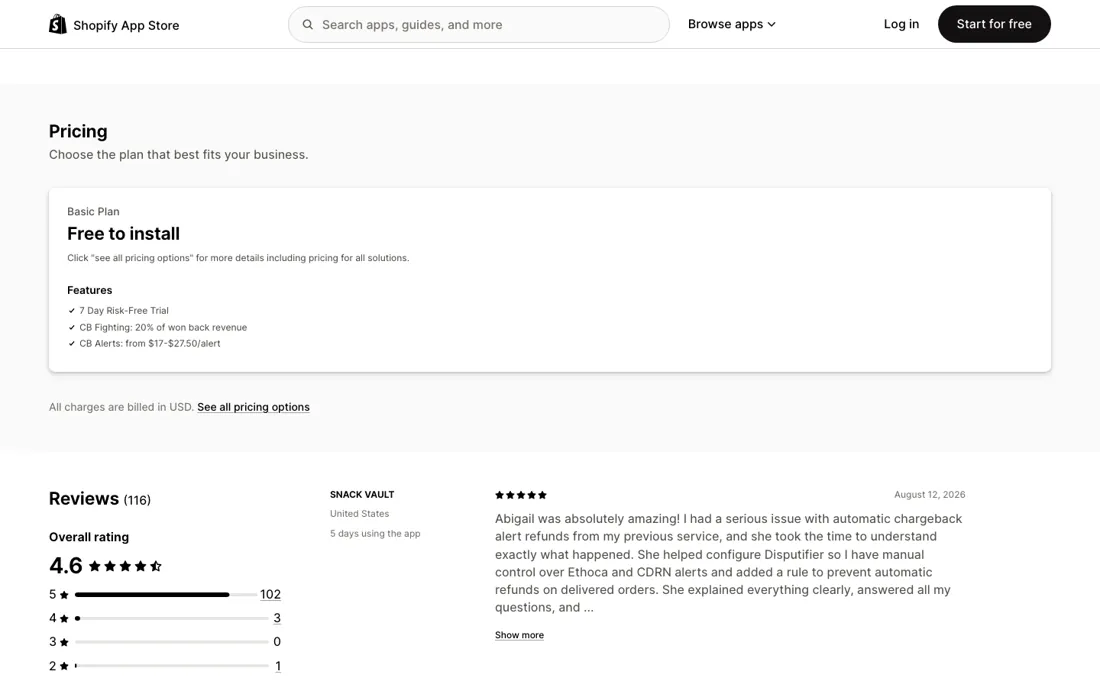
All four services bill per event — a fifth of each recovery, $17 to $27.50 an alert, five cents an order twice over — so the cost lands after the fact and scales with exactly the thing you are trying to reduce. Model your worst chargeback month before you switch alerts on, not your average one. The reviews deserve a straight look too. The 4.6 average across 125 reviews, read again on 17 September 2026, is not a middle: 87% are five stars and twelve of the one hundred and twenty-five are a single star, with almost nothing in between.
That shape has held while the count grew — on 22 August the same listing showed 4.6 from 88 reviews with nine one-stars, so both ends have filled at roughly the same rate. The most recent one-star we read, from June 2026, describes a security incident at the vendor and a dispute over unpaid invoices and billing descriptors; Disputifier replied in July that it does not block merchants from moving providers and disputes the account of the charges.
We have not verified either side and are not taking one. What the pattern does show is where the friction sits: merchants either rate this perfect or fall out with it over invoices, not over whether disputes were won. And know what alerts cannot reach. Coverage depends on the shopper's bank and card: smaller issuers do not participate, Amex and Discover frequently cannot be set up, Klarna alerts do not exist yet and PayPal alerts are recent.
The prevention rate the vendor quotes is a ceiling for a well-covered card mix, not a promise for yours.
What Disputifier does
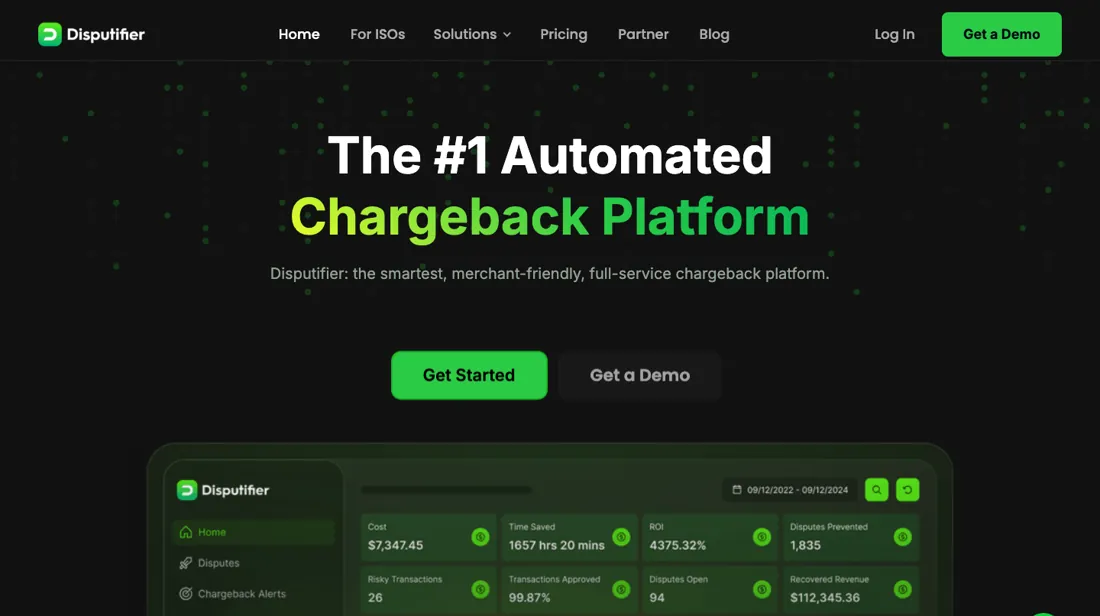
Chargeback automation for Shopify: submits dispute evidence for you, buys chargeback alerts that refund incoming disputes before they land, and screens orders for fraud and late shipments. Free to install; recovery costs 20% of every won chargeback (capped at $250 a win), alerts run $17-$27.50 each and the two prevention add-ons $0.05 an order.
What buyers report about Disputifier
Recurring themes from the buyer-review sites listed at the foot of this page, read in August 2026. We have not run Disputifier ourselves, so this is other buyers' experience rather than ours. We summarise it here because the complaints are usually the part a vendor page leaves out.
- • Support is what the positive reviews are actually about. Merchants name individual agents — one says a rep worked through roughly twenty separate issues inside ten minutes (August 2026) — and several credit the team with spotting a store problem that had nothing to do with chargebacks.
- • Onboarding multiple merchant IDs comes up as a smooth part: one merchant describes getting three MIDs enrolled without friction (August 2026).
- • The day-to-day is described as low-effort — install, navigate, leave it running — which fits a product whose whole pitch is that you stop fighting disputes yourself.
- • Billing is the complaint, and it is the same complaint over and over: charges that arrive after the merchant thought the relationship was over. Reviewers describe being billed following a cancellation request (January 2026, about $400), being charged for chargebacks that landed after they disconnected the store (May 2026), and one merchant reports $317 for what they say amounted to two orders (June 2026).
- • An unexpected $799 line for Visa's RDR prevention service (November 2025) is the sharpest example: the merchant says they never agreed to it and the vendor points to a pricing-change email as the notice.
- • Recovery rates are disputed in public. A merchant claims every case was lost; the vendor replies in the thread with 53 of 74 chargebacks won for that account. Whichever is right, it tells you the win rate is not something you should take on trust — measure your own before and after.
Where the ratings disagree. The gap here is not between platforms, it is between the average and the tail. The listing sits high because most merchants only meet the support team, but nearly every low review is a billing dispute rather than a product failure — and the vendor answers each one in the thread, usually with specifics. Read those exchanges rather than the score: they show that charges continue while disputes already in motion run their course through the card networks, that alerts bill per event, and that uninstalling the app is not the same thing as ending the enrolment. Cancel in writing, confirm the enrolment is closed on every merchant ID, and keep the reply.
When the paid plan is worth it
There are no tiers here, so the question is not which plan but which of the four services to switch on — and each has its own break-even. Recovery is the straightforward one: 20% of what they win, capped at $250, and nothing when they lose. On a $50 dispute you pay $10; on a $2,000 dispute the cap means $250 rather than $400. It only costs you money on chargebacks you would have won yourself, so the honest comparison is not against zero but against your current in-house win rate.
The vendor's own claim is that it wins around 60% of disputes; if you already win about that, you are paying a fifth of your recoveries for the hours back, not for extra revenue. Alerts run the other way, and they are the line to watch. At $17 to $27.50 an alert you pay per intercepted dispute whether or not you would have won it, and the alert resolves by refunding the shopper — so you lose the order revenue as well as the fee.
That trade works when the alternative is a chargeback you would probably lose plus a processor fee plus a hit to your dispute ratio, and it works badly on high-margin orders you would have won. The vendor says alerts stop 60-80% of incoming chargebacks, reaching 95% with the right processor and customer mix. The two $0.05-per-order add-ons, fraud screening and late-shipment notifications, are the cheapest and by far the most predictable: on 10,000 orders a month they are $500 each.
Unlike the other two they charge on every order rather than on every problem, which is the only part of this bill you can forecast.
How to actually use Disputifier
Start with recovery only, and start by measuring your own win rate over the last three months — 20% of recoveries is worth paying only against what you were actually winning before. Leave alerts off for the first month: that is the line item that runs away. Its value depends entirely on which banks and card types your shoppers use, so ask which of your processors and cards are actually covered before enabling them.
If you do turn alerts on, set a threshold above which disputes are fought instead of auto-refunded — their portal supports it, and without it your largest orders get refunded automatically. Use the 7-day risk-free trial to check the integration with your processor (Stripe, PayPal, Klarna, Authorize.net, Afterpay, Recharge) rather than to judge results; a week is not a dispute cycle. And keep your own record of every invoice and descriptor change from day one, because billing is where the negative reviews cluster.
Distilled from apps.shopify.com/disputifier and disputifier.com/pricing, read 19 August 2026.
More on Disputifier
Everything we publish about Disputifier links back here — the review stays the honest hub:
The ex-banker filter — the same yardstick on every review (how we review): My ex-banker filter is simple: does Disputifier remove a real cost — time, errors, missed revenue — bigger than what it charges?
Frequently asked questions
What will Disputifier actually cost me?
Nothing to install and everything on use, re-read on apps.shopify.com/disputifier and disputifier.com/pricing on 17 September 2026, unchanged since 19 August. Chargeback recovery is 20% of what they win back, capped at $250 per win — win a $50 dispute and they debit $10. Fraud prevention is $0.05 per order and “order not received” prevention another $0.05 per order. Alerts are the one that is not really published: the App Store listing bands them at $17 to $27.50 each, while the vendor's own page sells them as custom volume-based pricing by quote. There is no monthly subscription anywhere in this, which cuts both ways — you cannot read your bill off the pricing page in advance, because it is a function of how many disputes and orders you have.
If an alert refunds the order, do I still pay the processor's chargeback fee?
It depends which alert network catches it, and the vendor's own FAQ is unusually specific about this. Read 17 September 2026: with Ethoca and CDRN alerts the processor never sees the chargeback at all and so charges no fee. With RDR alerts the processor sees it as a resolved or accepted dispute — those do not count against your Visa dispute ratio, but your processor may still charge a fee on them. Setup time splits the same way: Ethoca and CDRN take one to two business days, RDR and Order Insight one to two weeks. And coverage depends on the shopper's card: smaller issuing banks do not participate, Amex and Discover often cannot be set up, PayPal alerts are recent and Klarna alerts do not exist yet.
Will my biggest orders get refunded automatically?
Only if you leave the default on, and this is the setting to find before you switch alerts on. An alert resolves by refunding the shopper, so on a high-margin order you would have won you lose the revenue and pay the alert fee. The vendor's FAQ says auto-refunds can be disabled entirely for manual review, and that you can set rules not to auto-refund above a threshold and fight those disputes instead. A review on the App Store listing dated 12 August 2026 describes exactly that being configured — manual control over Ethoca and CDRN alerts, plus a rule preventing automatic refunds on delivered orders — which is the clearest evidence we have that the control is real rather than a promise. Set the threshold on day one.
What should I weigh before buying Financial Operations software?
The bar here is higher than features. Check who actually holds the money and under what licence, whether client funds are segregated, what audit trail and permission controls you get, and how support behaves when something goes wrong mid-transaction. Anything touching payments should be able to answer those in writing; if it cannot, that is your answer.
Is this a hands-on review of Disputifier?
This is a researched assessment, not a hands-on test — where we've used a tool ourselves, we say so explicitly. We name what each tool is genuinely good and bad at, and we earn a commission only if you sign up, at no cost to you.
- Buyer reviews on the Shopify App Store listing, including its developer replies, read August 2026.
- Read 2026-08-19 and re-verified 2026-09-17 on apps.shopify.com/disputifier and disputifier.com/pricing.
- A dated screenshot of that pricing page, kept on this site as the receipt.
Others in this category
Reviewed financial operations tools that share ground with Disputifier — comparable in what they do, not drop-in swaps:
New dossiers, cost-traps we found, and tools that earned a keep — no hype, no sponsored-disguised-as-advice. Unsubscribe anytime.
This is our researched assessment — not a paid placement. The “Visit” links on this page are affiliate links: we may earn a commission if you sign up, at no extra cost to you, and it never changes our take. How we review →