Bitvavo Review (2026)MiCA-Regulated, 0.25% Taker Fee
 By Daan Haket · Researched and written with an AI assistant · who does what
The honest caveats are crypto-wide, not Bitvavo-specific: fees are only part of the cost (spread matters on small orders), and no exchange removes market risk — the platform being cheap and MiCA-regulated doesn't make the assets safe. Throughout this review we weigh it against Coinbase.
EU-based traders and builders who want a MiCA-regulated, euro-native exchange with low tiered fees, deep EUR pairs and a solid API for automation.
you're outside the EU (it's euro-centric), you trade exotic altcoins it doesn't list, or you need derivatives-first infrastructure.
Transparency: the “Visit” links on this page are affiliate links — we may earn a commission if you sign up, at no extra cost to you. No vendor can pay for a better review or verdict. How we make money →
Pricing (2026)
✓ Pricing re-verified 8 Oct 2026
No subscription — you pay per trade. EUR markets (Category A) run ten volume tiers. It is 0.15% maker / 0.25% taker below €100,000 of 30-day volume, then 0.10%/0.20% from €100,000, 0.09%/0.18% from €250,000, 0.08%/0.16% from €500,000 and 0.05%/0.14% from €1,000,000. Above that: 0.03%/0.12% from €2,500,000, 0.01%/0.10% from €5,000,000, 0.00%/0.08% from €10,000,000, 0.00%/0.04% from €25,000,000 and 0.00%/0.02% above €100,000,000. USDC markets (Category B) are a separate schedule from 0.05% maker and taker, and stablecoin pairs (Category C) from 0.10%; Bitvavo states that stablecoin trades do not count towards the 30-day volume that sets your tier.
Deposits are free by SEPA, iDEAL/Wero and Bancontact; Apple Pay, Google Pay, a credit card and PayPal each cost 1%, and EPS Überweisung 1.75%, and the page notes that deposit fees vary by country. Recovering crypto sent on the wrong network, where possible, costs a €50 administration fee. Margin positions carry a separate hourly borrowing fee, published at 0.0023% an hour on every listed asset, plus a 2% fee if the position is liquidated. Plans change — always verify the live price on their site.
Bitvavo trading fees by 30-day volume (EUR markets, 2026)
| 30-day volume | Maker | Taker |
|---|---|---|
| Below €100,000 | 0.15% | 0.25% |
| From €100,000 | 0.10% | 0.20% |
| From €250,000 | 0.09% | 0.18% |
| From €500,000 | 0.08% | 0.16% |
| From €1,000,000 | 0.05% | 0.14% |
| From €2,500,000 | 0.03% | 0.12% |
| From €5,000,000 | 0.01% | 0.10% |
| From €10,000,000 | 0.00% | 0.08% |
| From €25,000,000 | 0.00% | 0.04% |
| Above €100,000,000 | 0.00% | 0.02% |
Read on Bitvavo's own fees page, 25 August 2026, and unchanged on 8 October 2026. This table is Category A only — the EUR markets. USDC pairs run on a separate schedule from 0.05% and stablecoin pairs from 0.10%, and neither counts towards the 30-day volume that sets your tier here. Deposit, margin and liquidation costs sit outside this table and are in the pricing section above.
Bitvavo judged on each criterion
The questions people and research agents actually ask about Bitvavo, answered one at a time from what we read ourselves.
Ten volume tiers on EUR markets, from 0.15% maker and 0.25% taker below €100,000 of 30-day volume down to 0.00% and 0.02% above €100,000,000 — the full table is above. There is no subscription and no paid plan: the tier is a volume reward, not something you can buy. The catch worth knowing is that stablecoin trades do not count towards the volume that sets your tier.
This is the part we can speak to first-hand, because our own trading system executes on Bitvavo. You create a key under Settings → API with an IP whitelist and pick from six permissions — View, Trade, Withdraw, Include all subaccounts, Internal Transfer and Administrative. The secret is shown once and cannot be retrieved, so store it before you close the dialog. The friction is not the authentication but the order minimums: rejected orders are usually a minOrderInBaseAsset or minOrderInQuoteAsset problem, and the fix is reading those fields per market rather than hardcoding a size. There is an official Python SDK.
Margin is available with a published borrowing cost of 0.0023% an hour on every listed asset — the same rate across all 29 assets listed for borrowing — plus a 2% fee if a position is liquidated. That hourly rate is the number to model, because it is where a short position quietly gets expensive: 0.0023% an hour is about 0.055% a day, roughly 1.7% over a month and around 20% over a year on simple arithmetic. Small per hour, material on a position held for weeks (re-read 8 October 2026).
Euro-native, with deep EUR pairs — that is the reason to be here and also the limit. USDC markets exist as a separate fee category, and stablecoin pairs as a third. If your trading is dollar-denominated or you want exotic altcoins, this is the wrong venue and the fee schedule will not rescue it.
MiCA-regulated and euro-native, which is the substantive difference against offshore venues for an EU-based trader. Worth saying plainly: regulation governs the platform, not the assets — a regulated exchange does not make a volatile token less volatile.
Anyone outside the EU, anyone trading coins Bitvavo does not list, and anyone who needs derivatives-first infrastructure. The euro-centricity that makes the fees attractive inside the EU is exactly what makes it awkward outside it.
What the pricing page doesn’t say
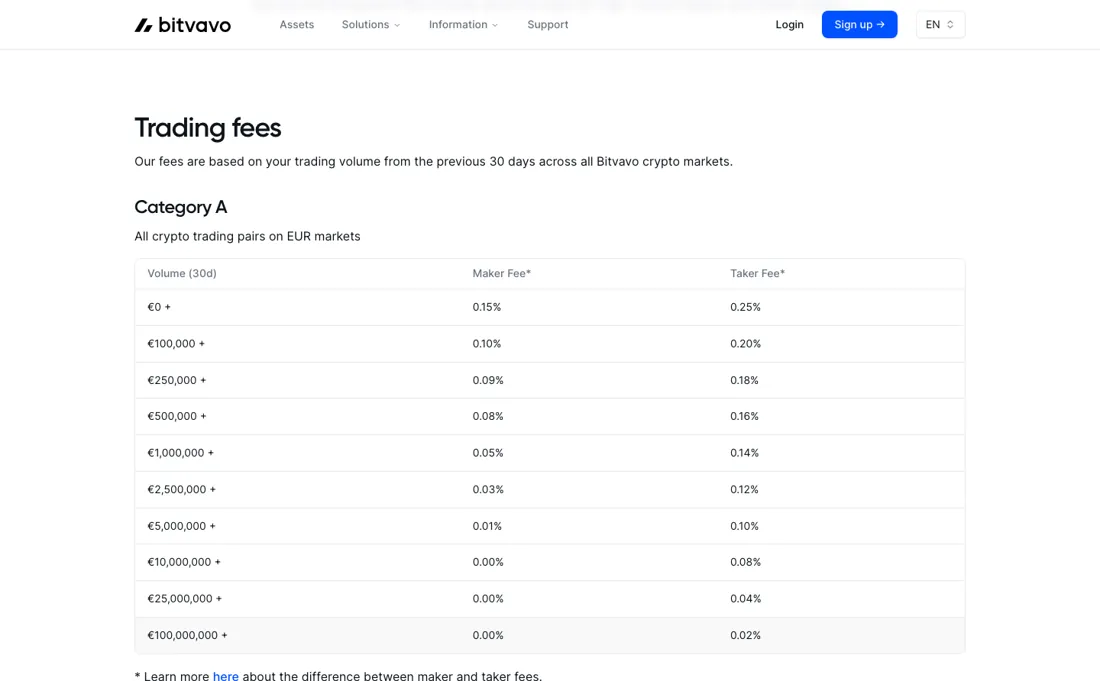
Note the disclosure: this is one of the few tools here we genuinely run — our own trading system executes on Bitvavo — which is experience, but also means we're an actual customer, not a neutral bystander.
Watch the video review
The video version of this review, from our YouTube channel.
⚡ Short on time? Watch the 30-second verdict Short.
What Bitvavo does
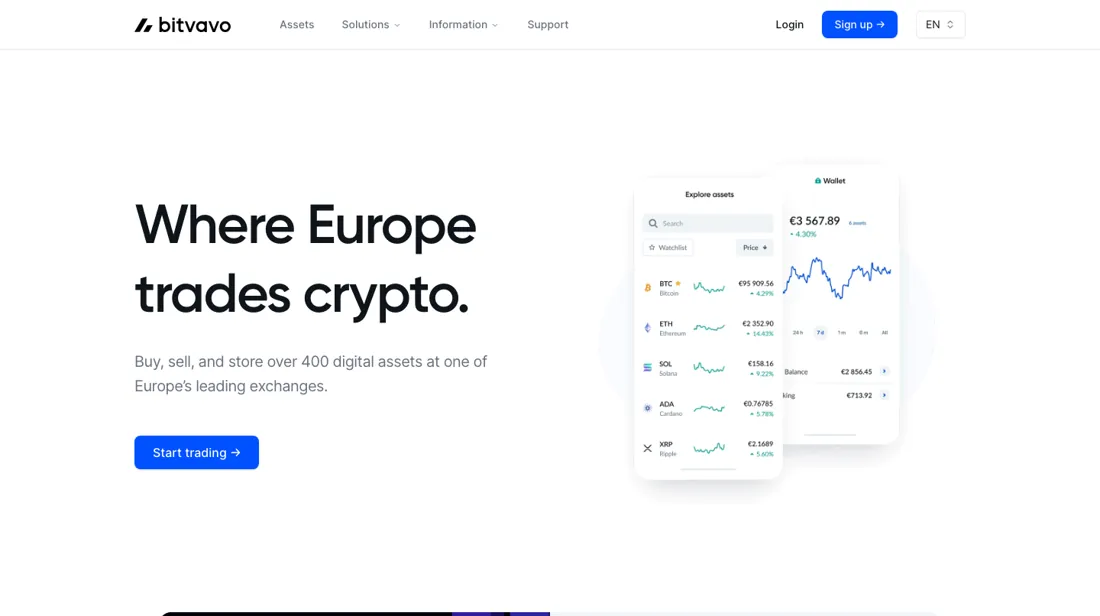
Dutch-regulated, euro-native crypto exchange with deep EUR pairs and an API for automation.
What buyers report about Bitvavo
Hands-on: not tested by usReported by buyers: Cryptowisser, CoinCompare, exchange-comparison sites, Google Play and , read August 2026, App Store October 2026
Themes from the buyer-review sites listed at the foot of this page, read in August 2026, App Store October 2026. We have not run Bitvavo ourselves, so this is other buyers' experience rather than ours. We summarise it here because the complaints are usually the part a vendor page leaves out.
- • SEPA deposits and withdrawals are free, and the fee schedule is honest: 0.15% maker and 0.25% taker below €100,000 monthly volume, falling across ten tiers.
- • Full CASP authorisation from the Dutch AFM since 27 June 2025, covering custody, trading and transfers across the EU and EEA. That is a real regulatory position, not a licence claim.
- • On the Dutch App Store (4.7 across 48K ratings, read October 2026) Bitvavo answers nearly every complaint in public, and in one case confirmed an outage on the day and that it was fixed the same day.
- • Support experience is inconsistent — some reviewers get quick help, others report long waits and answers that do not resolve the case.
- • Withdrawal and verification friction during account review comes up specifically. That is the moment it matters, so do your KYC before you need the money out.
- • Level 1 verification caps withdrawals at €25,000 a day; more requires upgrading the account.
- • Funding costs draw complaints, though the amounts in older reviews have moved: on the fee page we read on 18 August 2026 SEPA, iDEAL/Wero, Apple Pay and Bancontact were free, a credit card cost 1% and PayPal 2%; by 8 October 2026 the Apple Pay and PayPal rates had changed again (see the pricing section).
- • The exchange and the app get judged separately. On Google Play (4.3 across 26.7K ratings, read 13 August 2026) a June 2026 reviewer describes the app crashing until a reinstall and then failing at login, with the sign-in link going nowhere — Bitvavo's own reply blames the mobile browser and asks them to paste the link into another browser.
- • Google Play reviewers also ask for portfolio basics the app does not have: no return or profit-and-loss figure per asset or across the portfolio, with a deposit counted as profit, and no Advanced trading view — for that you leave the app for the browser.
- • App Store reviewers describe outages exactly when the market moves: on 3 March 2024 several could not sell, and Bitvavo confirmed a platform outage that day.
- • Features missing from the app come up too: a February 2024 reviewer could not place a stop-loss (Bitvavo's reply points to a stop-limit order in the advanced panel), and in December 2025 a reviewer found the per-asset profit-and-loss percentage gone after an update.
- • Delistings cost holders: a September 2023 App Store reviewer lost access to the Augur market, and Bitvavo replied that it reassesses listed assets periodically. A March 2026 reviewer complains that staking rewards keep being lowered.
Pages read (August 2026, App Store October 2026): App Store (NL)
When the paid plan is worth it
Bitvavo sells no subscription and has no paid plan to compare against a free one. The only low/high split is the volume-based maker/taker fee schedule. The API documentation calls it a "price tier" and files it under the default "Category A", and the account-fees endpoint returns it next to "Your trading volume in the last 30 days measured in EUR". The docs number that first tier 0. The schedule itself lives on the public fees page, which we read on 13 August 2026: ten tiers on EUR markets, from 0.15% maker and 0.25% taker below €100,000 of 30-day volume down to 0.00% and 0.02% above €100,000,000.
That makes the tier a volume reward rather than a plan you can buy, and one line on that page decides whether you ever climb it. Trades on stablecoin pairs do not contribute to the 30-day volume the schedule is measured on. So a stablecoin-heavy strategy can turn over a great deal and still leave you on the entry tier for everything else. Worth knowing about what a better tier does not fix: the documented default rate limit of 1000 weight points per minute is nowhere presented as tier-linked.
A better tier also does nothing about the mandatory operatorId field, which the FAQ says has to be included in all create, update and cancel order requests, nor about the per-market minimum order sizes that the same FAQ blames for rejected orders.
How to actually use Bitvavo
The vendor route is short. Create a private account at account.bitvavo.com/create, or contact the professional team at professional@bitvavo.com for a corporate account. The docs list enabling two-factor authentication under Before you start: scan a QR code with an authenticator app, then enter the 6-digit 2FA code it shows. Then, under Settings, open the API tab, add a new key, name it, set an IP whitelist, and choose among the six permissions: View access, Trade, Withdraw, Include all subaccounts, Internal Transfer and Administrative; you finish by entering a 2FA code and selecting Confirm. The secret is shown once and cannot be retrieved later.
Where this section comes from: our research notes (102 words)
Vendor material only — Bitvavo's own developer documentation (the get-started, rate-limits and FAQ pages plus the account-fees and market-fees endpoint pages), with the credential requirement cross-checked against the official Bitvavo Python SDK README on GitHub; we found no independent walkthrough worth citing. Fees re-read on Bitvavo's fees page (https://bitvavo.com/en/fees) on 8 October 2026: the deposit costs for Apple Pay, Google Pay and PayPal had changed, the list of borrowable assets had grown to 29, and the €50 recovery fee for wrong-network deposits is stated there.
Bitvavo's help centre answered our plain requests with an empty page, so no help-centre article was read.
Common Bitvavo setup mistakes
Where Bitvavo setups actually go wrong, and what it costs you when they do. Same sources as the setup notes above — not from a walkthrough we ran ourselves.
The friction comes after.
- Bitvavo's own FAQ flags five traps.
- Rejected orders caused by minimum values, fixed by reading minOrderInBaseAsset and minOrderInQuoteAsset from market data.
- Balances that look wrong because the onHold amount is blocked and fees are charged with a lag.
- WebSocket rejections that do not say which order failed unless you attach a requestId.
- Reconnection loops that produce 429 errors.
- And a mandatory operatorId on every create, update and cancel.
- Identity verification sits behind the login.
Bitvavo vs Bybit, side by side
Each column shows the vendor’s own published entry price, read on the date shown. Entry prices can cover different services or units, so check what each one buys. We do not average them into a score.
Both names above are affiliate links: we may earn a commission if you sign up, at no extra cost to you. Neither changes what this table says.
The natural comparison is Kraken or Bybit — Kraken is the classic global peer; Bybit leans derivatives — Bitvavo's edge is euro on/off-ramps and EU regulation. Weigh it against Coinbase on the job you actually need done.
Frequently asked questions
What does trading actually cost on Bitvavo?
Read on their fees page on 8 October 2026: on EUR markets you start at 0.15% maker and 0.25% taker, and the schedule steps down through ten volume tiers — 0.10%/0.20% from €100,000 of 30-day volume, 0.05%/0.14% from €1m, 0.00%/0.08% from €10m and 0.00%/0.02% above €100m. USDC markets run on their own schedule from 0.05% maker and taker. Funding is where the other cost hides: SEPA, iDEAL/Wero and Bancontact deposits are free, but Apple Pay, Google Pay, a credit card or PayPal costs 1%, four times the entry-tier taker fee, and EPS Überweisung 1.75%.
Can I run a trading bot on it, and what does the API require?
Yes, and the friction is documented rather than hidden. Bitvavo's own docs put the default rate limit at 1,000 weight points per minute and require an operatorId field on every create, update and cancel order request, so a bot written before that requirement gets rejected. Keys are made under Settings > API with an IP whitelist and a choice of six permissions, two-factor authentication has to be on first, and the secret is shown once and cannot be retrieved later. None of that changes with volume.
Do stablecoin trades help me reach a cheaper fee tier?
No. The fees page states that trades on stablecoin pairs do not contribute to the fee-schedule 30-day volume, and prices them on a separate Category C schedule starting at 0.10% maker and taker rather than on the EUR schedule. High stablecoin turnover can leave you paying entry-tier rates on everything else.
What happens if I send crypto on the wrong network?
Bitvavo's fees page (read 8 October 2026) says depositing digital assets is free, but crypto sent via the wrong network, or an asset Bitvavo does not support, may be lost; in some cases Bitvavo may be able to help recover it for a €50 administration fee. Check the network before the first deposit of every new asset.
Is this a hands-on review of Bitvavo?
This is a researched assessment, not a hands-on test — where we've used a tool ourselves, we say so explicitly. We name what each tool is good and bad at, and we earn a commission only if you sign up, at no cost to you.
- Buyer reviews on Cryptowisser, CoinCompare, exchange-comparison sites, Google Play and the Dutch App Store, read August 2026, App Store October 2026.
- Re-verified 2026-10-08, read on their own fees page.
- A dated screenshot of that pricing page, kept on this site as the receipt.
Others in this category
Reviewed financial operations tools that share ground with Bitvavo — comparable in what they do, not drop-in swaps:
Also in financial operations, for browsing rather than as an alternative:
New reviews, price changes we recorded, and the cost conditions we found. No sponsored placements. Unsubscribe anytime.
This is our researched assessment — not a paid placement. The “Visit” links on this page are affiliate links: we may earn a commission if you sign up, at no extra cost to you, and it never changes our take. How we review →