Navan Review (2026)Free to 300 Staff, Expense $15 From User 6
 By Daan Haket · Researched and written with an AI assistant · who does what
'Free' is real but has a mechanism: Navan earns commission on bookings made through its inventory, so the platform's incentive is that your travel flows through Navan, and pricing on specific routes/hotels deserves an occasional spot-check against direct booking. Throughout this review we weigh it against Expensify.
companies of up to 300 employees that want self-serve travel booking with built-in policy control, free on Navan Business, and optionally unified expense management on top.
your travel volume is a few trips a year (any booking site does), or you need expense-only tooling without the travel layer.
Transparency: the “Visit” links on this page are affiliate links — we may earn a commission if you sign up, at no extra cost to you. No vendor can pay for a better review or verdict. How we make money →
Pricing (2026)
✓ Pricing re-verified 24 Sep 2026
Navan Business is free for companies of up to 300 employees, with no limit on trips, and Navan Expense is free for the first 5 monthly expensing users and then $15 per user per month. Above 300 employees the plan is Navan Enterprise, priced by quote. An expensing user is anyone who submits a transaction in the month, so the expense bill follows who actually files, not headcount.
The travel side is free because it is funded by travel-supplier commissions, which makes the question not what it costs but what it steers; note that corporate negotiated rates sit in the Enterprise column of the plan table, not the Business one. Our July and August 2026 readings found no amount on this URL and put the free expense threshold at 15 users; the page now says 5, and this text follows the page. Plans change — always verify the live price on their site.
What the price did
We capture Navan’s own pricing page every month and keep the figures, so this is our record of the page — not a forecast, and not someone else’s summary.
Our July and August 2026 captures of Navan's pricing URL were identical and contained no amount, and on 17 August 2026 the page still read as marketing rather than a price list; from those readings we put the free Expense threshold at 15 users and the per-user rate around $15. On 24 September 2026 navan.com/pricing carried a full plan table: Navan Business free for companies of up to 300 employees, Navan Expense free for the first 5 monthly expensing users and then $15 per user per month, Navan Enterprise by quote. The per-user rate matched our earlier reading; the free threshold did not (it is 5 users, not 15), and the review was corrected the same day.
The honest knock
The free Business plan stops at 300 employees and lists corporate negotiated rates as an Enterprise feature; expense management is free for 5 users and $15 per user per month after that.
Watch the video review
The video version of this review, from our YouTube channel.
⚡ Short on time? Watch the 30-second verdict Short.
What Navan does
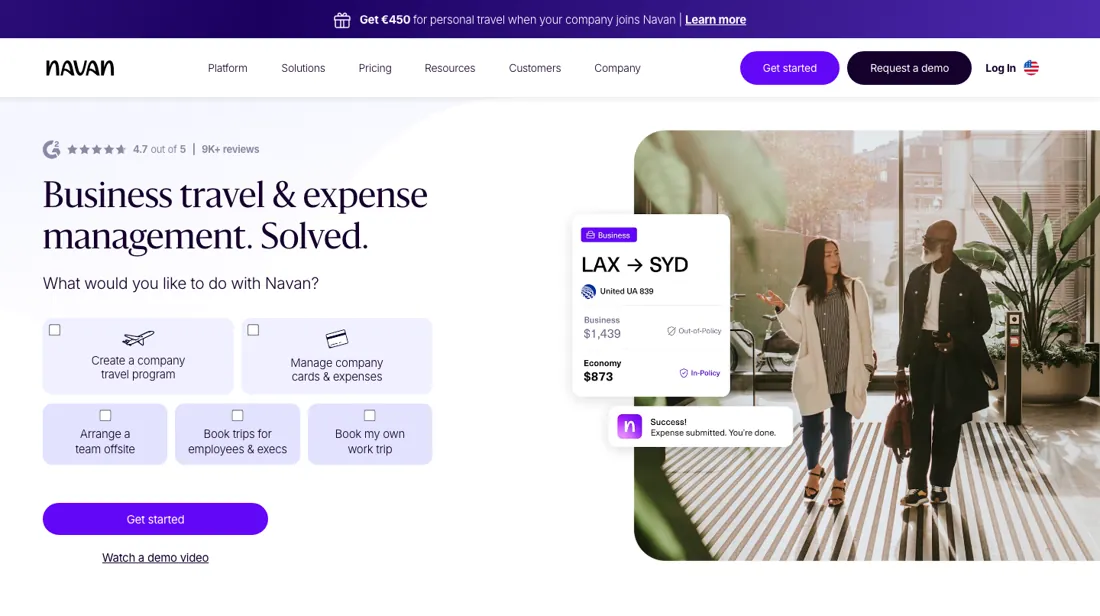
Business travel and expense management in one. Book trips, automate expense reports and control spend with real-time visibility.
What buyers report about Navan
Hands-on: not tested by usReported by buyers: Gartner Peer Insights, Tekpon and practitioner reviews, read August 2026
Themes from the buyer-review sites listed at the foot of this page, read in August 2026. We have not run Navan ourselves, so this is other buyers' experience rather than ours. We summarise it here because the complaints are usually the part a vendor page leaves out.
- • Booking and expense in one system with policy controls built in, which is the reason finance teams choose it over stitching two tools together.
- • Negotiated rates and the automatic expense capture do save real admin time.
- • It does not always surface the cheapest option — reviewers report finding better fares for the same flights on Expedia and elsewhere. Spot-check before booking.
- • Service fees are reported at levels reviewers call steep, including around $70 for certain services.
- • Expenses can appear twice through glitches, and auto-uploaded photo expenses are hard to edit.
- • Corporate card reliability abroad and rental car cost surprises are both named concerns.
What free actually costs
Navan now publishes its plan table: read on navan.com/pricing on 24 September 2026, after our July and August captures of the same URL found no amount at all. The shape is still the whole story. Navan Business is free for companies of up to 300 employees, with no limit on trips, and covers booking, policy and approval workflows and 24/7 travel support. It is funded by travel-supplier commissions. Navan Expense is free for the first 5 monthly expensing users and then $15 per user per month, and above 300 employees the plan is Navan Enterprise, priced by quote.
Because the travel side is commission-funded, the question is not what it costs but what it steers. Navan earns when your travel flows through its inventory, so the platform's incentive and your procurement team's are not identical. Two things to confirm before rolling it out: that your negotiated corporate rates and preferred suppliers survive the policy engine rather than being quietly deprioritised, and that fares on your most-travelled routes hold up against direct booking.
A quarterly spot-check on a handful of routes costs an hour and is the only way to know. One line on the plan table matters here: corporate negotiated rates are listed as an Enterprise feature, not a Business one, so a company under 300 staff with its own hotel or airline deals should ask in writing whether those rates load on the free plan. The five-free-users threshold on Expense lets a very small team pilot unified travel and expense at zero, and the meter is monthly expensing users (anyone who submits a transaction that month), not headcount.
At $15 a user, a fifty-person company where everyone files expenses pays for 45 users, $675 a month, for the expense layer on top of free travel; if only twenty of them file, it is $225. That is the number to compare against a standalone expense tool plus whatever you use for booking today. Our earlier reading put the free threshold at fifteen users; the page says five, and we corrected the review on 24 September 2026.
A second way in arrived in September, and it is free. Navan Edge — read on navan.com/product/navan-edge on 18 September 2026 — is an early-access AI travel assistant aimed at frequent solo business travellers rather than at companies: free, no credit card, 24/7 access to human agents by chat or phone, and an explicit rule that it never books, changes or cancels a trip without your confirmation. What the page does not carry is the reward arithmetic.
Navan's partner announcement the same week described a $25 traveller bonus after a first booking over $250 and 5% rewards on all hotel stays; neither figure appears on the Edge page, which instead ran a dated banner offering 10% back on qualifying hotel stays booked by 30 September 2026. One condition applies to all of it, which Navan's partnerships team spelled out to us in writing on 24 September 2026: “Users must complete their first trip to receive any rewards or bonuses.
Cancelled trips do not count.” Read the offer on the page before you count on it — these are campaigns that move, not a standing rate.
Our monthly capture read this vendor's pricing page in July 2026 and again in August 2026, and the amounts were the same both times. We keep watching — the registry records what moves.
How to actually use Navan
Spot-check the fares, monthly. Business Travel is genuinely free to you because Navan earns commission on bookings made through its inventory, which means the platform's incentive is that your travel flows through it. Once a month, take a route someone is about to book and compare the Navan price against booking direct. That is not suspicion, it is the mechanism, and it is the only thing 'free' actually costs you.
Confirm your negotiated rates survive the policy engine before you migrate anyone. If you hold corporate rates with a hotel chain or an airline, check they appear in search, that they are marked as preferred, and that the policy rules do not quietly steer bookers past them. Navan's plan table lists corporate negotiated rates as an Enterprise feature, so on the free Business plan ask first whether yours can be loaded at all.
Then use the expense product's 5 free users as a genuine pilot rather than a demo. Five seats is enough for a finance lead and a few frequent travellers to run a full month of real expenses, which is the only way to find out whether the unified travel-and-expense story holds for how your people actually submit receipts. Beyond that it is $15 per monthly expensing user (navan.com/pricing, read 24 September 2026), counted by who submits a transaction that month, so budget for the people who actually file rather than for headcount.
Distilled from Navan's own pricing page, navan.com/pricing, read 24 September 2026. Every figure in our text appears on that page: Navan Business free for companies of up to 300 employees, Navan Expense free for the first 5 monthly expensing users and then $15 per user per month, Navan Enterprise by quote.
The natural comparison is TravelPerk or Ramp (for expense) — TravelPerk is the direct travel rival; Ramp attacks the expense side — Navan's edge is the free, unified travel core. Weigh it against Expensify on the job you actually need done.
Frequently asked questions
Is Navan really free?
The travel product is, for companies of up to 300 employees: Navan Business is funded by commissions from travel suppliers rather than by a subscription, and there is no limit on trips. The Expense product is free for the first 5 monthly expensing users and then $15 per user per month (navan.com/pricing, read 24 September 2026). Above 300 employees the plan is Navan Enterprise, priced by quote.
What is the catch with commission-funded travel software?
Not a hidden fee — an incentive. The platform earns when you book through it, so the thing to test is whether your own negotiated hotel and airline rates are loaded and surfaced, and whether the policy engine steers travellers toward inventory that pays Navan. Ask for that in the demo with your own routes.
When does it stop being free?
In two places. On Expense, at the sixth monthly expensing user, where $15 per user per month starts; the count is people who submit a transaction that month, not headcount. On travel, when the company passes 300 employees, where Navan Business gives way to Enterprise pricing by quote. If you only need travel booking and policy below that size, the free plan genuinely covers it.
Is this a hands-on review of Navan?
This is a researched assessment, not a hands-on test — where we've used a tool ourselves, we say so explicitly. We name what each tool is good and bad at, and we earn a commission only if you sign up, at no cost to you.
- Buyer reviews on Gartner Peer Insights, Tekpon and practitioner reviews, read August 2026.
- Read 24 September 2026 on navan.com/pricing.
Others in this category
Reviewed financial operations tools that share ground with Navan — comparable in what they do, not drop-in swaps:
New reviews, price changes we recorded, and the cost conditions we found. No sponsored placements. Unsubscribe anytime.
This is our researched assessment — not a paid placement. The “Visit” links on this page are affiliate links: we may earn a commission if you sign up, at no extra cost to you, and it never changes our take. How we review →