 Dify Review (2026)
'Free' self-hosting isn't free — you own the servers, updates and reliability, and model usage bills separately once the included message credits run out. Throughout this review we weigh it against LangChain.
Visit Dify → Affiliate link — the rest of this page is the honest version, including who should skip it.
Watch the 2-minute review
Same honest take, in video form — from our YouTube channel.
Pricing (2026)
✓ Pricing re-verified 21 Aug 2026
Source-available and free of a software fee to self-host — the Community Edition ships under the Dify Open Source License, a modified Apache 2.0 with additional conditions — while the managed Dify Cloud adds a free Sandbox, Professional at $59/mo ($590/yr) and Team at $159/mo ($1,590/yr), each priced per workspace (2026). Self-hosting still costs you infrastructure, model usage and any commercial licence those terms require.
Cloud plans include message credits for supported model providers; once those run out you connect your own provider API key and pay that provider directly. Plans change — always verify the live price on their site.
The honest knock
Dify Cloud takes that infrastructure work off your hands, but every cloud plan is a single workspace, and multiple workspaces, SSO and a commercial licence sit in quote-only Enterprise. It's powerful, but self-hosting it well needs technical comfort.
What Dify does
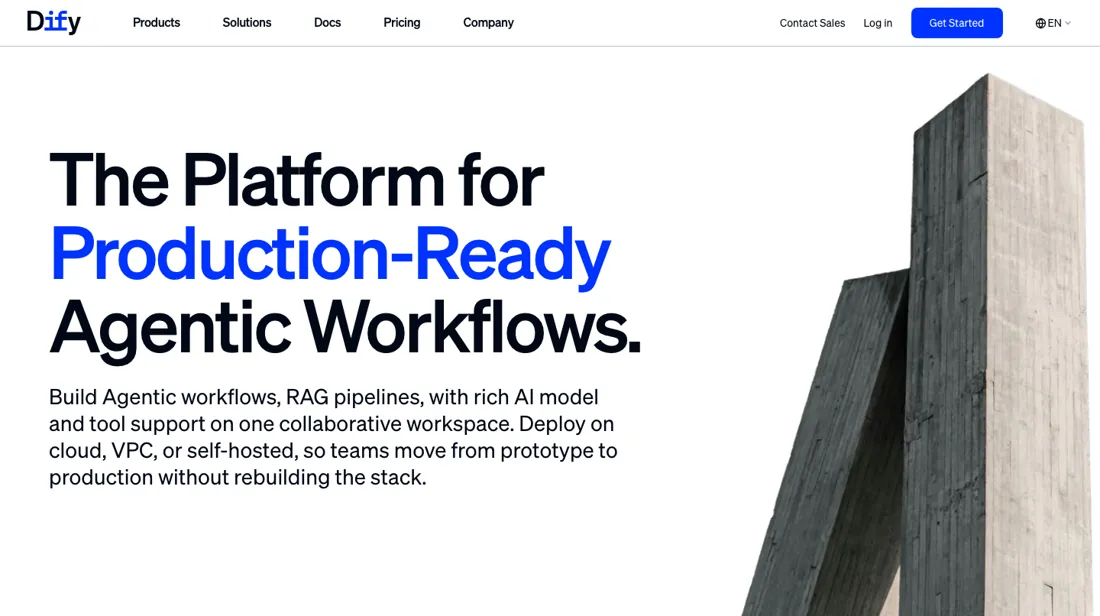
Source-available platform for LLM apps and agent workflows: visual builder, RAG pipelines, model-agnostic. The Community Edition is free of a software fee to self-host, but you own the servers, updates and reliability. Managed Dify Cloud runs $59/month on Professional, priced per workspace.
What buyers report about Dify
Recurring themes from the buyer-review sites listed at the foot of this page, read in August 2026. We have not run Dify ourselves, so this is other buyers' experience rather than ours. We summarise it here because the complaints are usually the part a vendor page leaves out.
- • The visual workflow builder genuinely bridges no-code and pro-code, with RAG, agents, model management and observability in one place.
- • Self-hosting the Community Edition carries no software fee under the Dify Open Source License — a modified Apache 2.0 with additional conditions — and it is not bound by Dify Cloud's plan quotas; what limits you is your own infrastructure and your model provider. For regulated teams the draw is that control over deployment and data boundaries, though self-hosting does not by itself establish compliance.
- • Self-hosting means you own the infrastructure. Without engineering capacity that is a burden, not a saving — though it is a self-hosting trade-off rather than a Dify-wide one, since Dify Cloud is managed and runs no servers on your side.
- • SSO and multiple workspaces are Enterprise-only — every Cloud plan from Sandbox to Team is a single workspace — so larger organisations end up in a quote-only conversation (dify.ai/pricing, read 24 August 2026).
- • Documentation lags behind the features, and reviewers ask repeatedly for more of it.
- • Cloud plans cap out: free Sandbox has 200 message credits, Professional $59/month for 5,000, Team $159 for 10,000. Growing teams get pushed to a custom quote.
When the paid plan is worth it
Dify Cloud has two paid steps, both priced per workspace, and they are bought with seats, storage and quota rather than with features. Sandbox is free: 200 message credits, 1 member, 5 apps, 50 knowledge documents, 50MB of storage and 30 days of log history. Professional at $59 a month, or $590 a year, moves that to 5,000 credits a month, 3 members, 50 apps, 500 documents, 5GB, unlimited log history and no API rate limit.
Team at $159 a month, or $1,590 a year, buys 10,000 credits a month, 50 members, 200 apps, 1,000 documents and 20GB. The larger figure on the page is the annual one; the monthly rate is the higher of the two. Two things a paid plan does not fix. Model bills stay separate, and Dify says so plainly: message credits exist to try models from OpenAI, Anthropic, Gemini, xAI and Tongyi, and once they are used up you switch to your own API key.
The subscription is never the whole cost. And every cloud plan is one workspace. Multiple workspaces, SSO and a commercial licence sit in Enterprise, which is quote-only.
Our monthly capture read this vendor's pricing page in July 2026 and again in August 2026, and the amounts were the same both times. We keep watching — the registry records what moves.
How to actually use Dify
Two very different starting points. Dify Cloud is managed SaaS: you sign up and build, with no infrastructure to operate. Everything below is the self-hosted Community Edition, which is a clone and a compose file — and the docs are exact about the floor. You need 2 CPU cores and 4 GiB of RAM, Docker Compose 2.24.0 or later, and on macOS a Docker virtual machine configured with at least 2 virtual CPUs and 8 GiB of memory.
You clone the repository at its latest release tag, move into dify/docker, copy .env.example to .env, then run docker compose up -d. That brings up 7 core services and 8 dependent components, including Postgres, Redis, Weaviate, nginx, two SSRF proxies and two sandboxes, plus a one-time init_permissions container whose Exited status is expected rather than a fault. Open http://localhost/install to create the admin account. Budget for the upkeep this implies: configuration changes mean editing docker/.env and restarting, and the docs warn that upgrade steps vary between releases, so each upgrade means reading that release's guide.
Distilled from Dify's own documentation, "Deploy Dify with Docker Compose" (docs.dify.ai/en/self-host/deploy/quick-start/docker-compose) and the machine-readable pricing at dify.ai/pricing.md, read 21 August 2026.
The natural comparison is Flowise or a managed platform like Lindy.ai — other LLM-app builders, self-host or managed. Weigh it against LangChain on the job you actually need done.
More on Dify
Everything we publish about Dify links back here — the review stays the honest hub:
The ex-banker filter — the same yardstick on every review (how we review): My ex-banker filter is simple: does Dify remove a real cost — time, errors, missed revenue — bigger than what it charges?
Frequently asked questions
What should I weigh before buying IT & Productivity software?
Judge it on evidence rather than adjectives. Look for a published security page, single sign-on and role controls on the plan you would actually buy (they are often gated to higher tiers), a status page with real incident history, and a clear answer on where your data is stored. If the tool will hold anything sensitive, those four answers matter more than any feature comparison.
Is this a hands-on review of Dify?
This is a researched assessment, not a hands-on test — where we've used a tool ourselves, we say so explicitly. We name what each tool is genuinely good and bad at, and we earn a commission only if you sign up, at no cost to you.
- Buyer reviews on Product Hunt and practitioner reviews, read August 2026.
- Dify’s own published pricing page.
Others in this category
Reviewed it & productivity tools that share ground with Dify — comparable in what they do, not drop-in swaps:
New dossiers, cost-traps we found, and tools that earned a keep — no hype, no sponsored-disguised-as-advice. Unsubscribe anytime.
This is our researched assessment — not a paid placement. The “Visit” links on this page are affiliate links: we may earn a commission if you sign up, at no extra cost to you, and it never changes our take. How we review →