 Gravity Forms Review (2026)Elite Wins From Five Sites
Gravity Forms is a WordPress-only plugin — no WordPress, no Gravity Forms — and its real power often lives in paid add-ons and third-party extensions, so a genuinely advanced setup can cost more than the base license suggests.
Visit Gravity Forms → Affiliate link — we may earn a commission if you sign up; it does not change what this page says.
Watch the 2-minute review
The video version of this review, from our YouTube channel.
⚡ Short on time? Watch the 30-second verdict Short.
Pricing (2026)
✓ Pricing re-verified 23 Sep 2026
Annual WordPress licences, unchanged since 1 Sep 2026: Basic $59/yr (1 site, standard support), Pro $159/yr (3 sites, standard support), Elite $259/yr (unlimited sites, WordPress Multisite, priority support and every first-party add-on). Which add-on sits where decides the tier as often as the site count: Basic carries the email-marketing and anti-spam add-ons (HubSpot, Mailchimp, ActiveCampaign, Brevo, Kit, reCAPTCHA, Cloudflare Turnstile among them); Pro adds the payment and workflow ones (Stripe, PayPal Checkout, Square, Mollie, Zapier, Slack, Dropbox, Zoho CRM); Elite alone has Webhooks, Salesforce, Google Analytics, Coupons, Partial Entries, Signature, Survey, Quiz, Polls, User Registration, Conversational Forms, Advanced Post Creation and 2Checkout.
No trial version, only an online demo. No renewal rate is published on the page. Refund policy: 30 days from each payment, covering original purchases, renewals and upgrades; a refund request deactivates the licence immediately and a deactivated licence cannot be renewed or reactivated; no partial refunds. On WordPress.com the plugin needs the Business plan with a custom domain. The third-party extensions most advanced builds lean on are separate purchases with their own ladders, all re-read 23 Sep 2026 and unchanged: Gravity Perks $59/$169/$299 a year, Gravity Flow $99/$299/$447, and GravityKit $119 for GravityView, $199 for GravityView Pro and $396 for the All Access Pass, the three GravityKit prices still shown with a first-year sale ($79.34, $132.67 and $264.01). Plans change — always verify the live price on their site.
The honest knock
Two honest notes. It's developer-friendly rather than beginner-slick; non-technical users may find hosted builders more polished. For a WordPress site, though, it's the reliable gold standard.
What Gravity Forms does
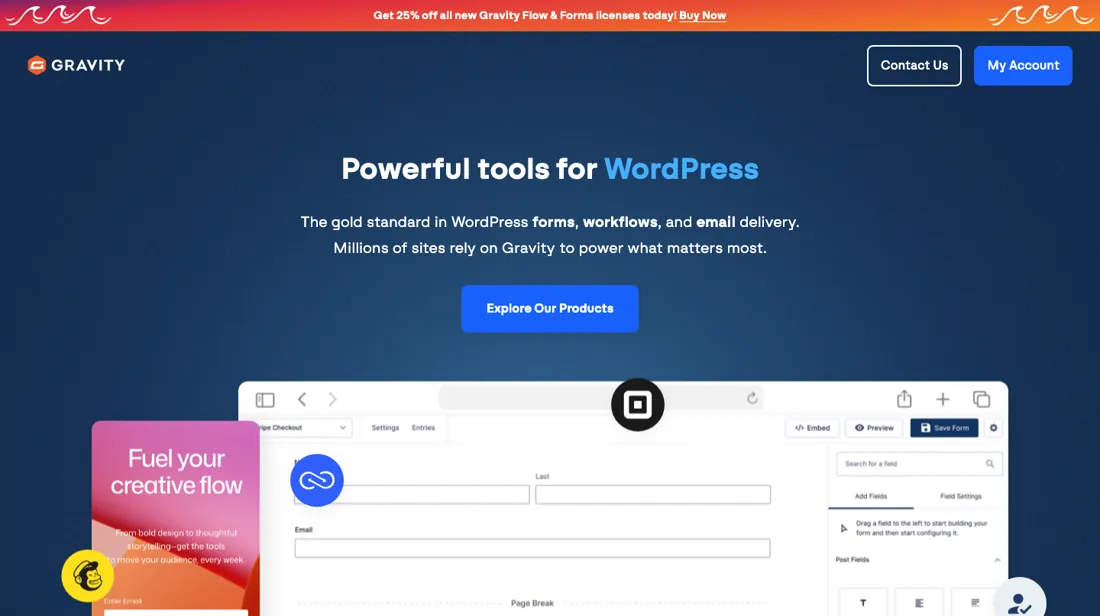
Self-hosted WordPress form builder with conditional logic, payments and deep integrations.
What buyers report about Gravity Forms
Recurring themes from the buyer-review sites listed at the foot of this page, read in August 2026. We have not run Gravity Forms ourselves, so this is other buyers' experience rather than ours. We summarise it here because the complaints are usually the part a vendor page leaves out.
- • The renewal price is the same as the first year — unusual in WordPress plugins, and it makes the real cost lower than it first looks.
- • $59 a year for one site, $159 Pro for three, $259 Elite with everything. Conditional logic and add-ons cover almost any form you need.
- • An expired licence cannot be reactivated. You buy a new one. Miss the renewal and you are repurchasing, not renewing.
- • A lapsed licence leaves the plugin working but cuts off updates including security patches, and blocks new installs. For anything commercial that is not tenable.
- • No lifetime licence and no monthly option, so a six-week campaign still costs a year.
- • Some specialty add-ons come from third-party developers at $30-80 a year each on top.
When the paid plan is worth it
The decision rule turns on one number: how many sites you run. Basic is $59 a year for 1 site, Pro $159 for 3 sites plus payments, and Elite $259 for unlimited sites, WordPress Multisite, priority support and every first-party add-on. Run the per-site sum and the crossover lands exactly at three. Two Basic licences cost $118, less than Pro at $159; three cost $177, more. So at one or two sites Basic is cheaper even bought twice, and at three or more Pro wins on price alone.
Pro also unlocks payments, so if you need to take money on a single site the site count stops deciding. Elite is the one to think about differently. Beyond unlimited sites it bundles all the first-party add-ons, and that is where the real money in this ecosystem sits: the heavy lifting is done by third-party extensions with their own ladders. Gravity Perks runs $59, $169 or $299 a year; Gravity Flow $99, $299 or $447; GravityView $119, with a $199 Pro tier and a $396 all-access pass.
Several of those upper tiers cost more than Elite itself. List the extensions you intend to use before comparing the three tiers -- the licence is usually the smaller half of the bill.
How to actually use Gravity Forms
Count your sites and decide whether you need payments — those two questions settle the tier on their own. Basic at $59 a year covers one site, Pro at $159 covers three and adds payments, and Elite at $259 covers unlimited sites, WordPress Multisite and every first-party add-on. The arithmetic is simple: Elite beats buying separate Basic licences from five sites onward, and it is cheaper than a second Pro licence the moment you pass three.
Before you pick, list the add-ons your build actually needs. Elite includes the first-party ones, but the extensions that do much of the heavy lifting in advanced setups — GravityView, Gravity Flow, the Perks collection — are third-party and run from $59 to $447 a year by tier. A genuinely advanced form can cost more in extensions than in the licence, and that total is the number to compare against a hosted builder.
And check the obvious constraint first: this is a WordPress plugin and nothing else. If part of your stack is not WordPress, Gravity Forms does not reach it. It is developer-friendly rather than beginner-slick, so if the person building your forms is not technical, a hosted builder will feel more polished — and if they are, this is the reliable standard for a reason.
Distilled from gravityforms.com/pricing/, read 23 September 2026 (previously 1 September 2026) - the three licence tiers with their site counts and support levels, the Basic, Pro and Elite add-on columns, and the FAQ on trials, WordPress.com and themes; gravityforms.com/refund-policy/, read the same day - the 30-day window per payment, deactivation on request, no partial refunds. The third-party extension prices come from the vendors' own pricing pages, re-read 23 September 2026 with no change: gravitywiz.com/pricing/ (Gravity Perks $59/$169/$299), gravityflow.io/pricing/ (Core $99, Pro $299, Ultimate $447) and gravitykit.com/pricing/ (GravityView $119, GravityView Pro $199, All Access Pass $396 list, with a first-year sale running).
The natural comparison is Typeform or Jotform — hosted SaaS builders that are slicker and platform-agnostic; Gravity Forms wins on WordPress control and a flat annual cost.
Frequently asked questions
I run one site but need webhooks and Salesforce. Is Basic or Pro enough?
Neither. Read 23 September 2026, Webhooks and the Salesforce add-on are both in the Elite-only column of the pricing page, so one site that needs either one costs $259 a year, not $59. Elite is also the only tier with Google Analytics, Coupons, Partial Entries, Signature, Survey, Quiz, Polls, User Registration and Conversational Forms. HubSpot, by contrast, is in the Basic column, and Stripe, PayPal Checkout, Square, Mollie and Zapier arrive at Pro. So the site-count rule elsewhere on this page - Basic for one or two sites, Pro from three, Elite from five - only holds if every add-on you need is in the cheaper column. Check your list against the three columns first; a single Elite-only add-on overrides the arithmetic.
Can I try Gravity Forms first, and what if it does not work out?
There is no trial. Read 23 September 2026, the FAQ says so plainly and points to documentation, an online demo and the terms instead. The safety net is the refund policy: 30 days from any payment, and that covers renewals and upgrades as well as the first purchase, so an automatic renewal you did not want can be reversed inside the window. Two conditions matter before you rely on it. Asking for a refund deactivates the licence at once, and a deactivated licence cannot be renewed or reactivated, so you would buy a new one to come back. And there are no partial refunds, so an unwanted upgrade is refunded as the upgrade payment only, and only within 30 days of it.
Will Gravity Forms run on a WordPress.com site?
Only on a paid plan that allows plugins. Read 23 September 2026, the FAQ says WordPress.com sites need the Business plan with a custom domain configured before WordPress.com will let you install it. On self-hosted WordPress, Gravity Forms recommends the same system requirements as WordPress itself: PHP 7.4 or later, MySQL 5.7 or later and the latest WordPress. It will not run anywhere else, because it is a WordPress plugin rather than a hosted form service. On theme conflicts, the FAQ says support will ask you to switch to a default Twenty-series theme to test, and if the problem disappears the fix is the theme author's job.
What should I weigh before buying IT & Productivity software?
Judge it on evidence rather than adjectives. Look for a published security page, single sign-on and role controls on the plan you would actually buy (they are often gated to higher tiers), a status page with real incident history, and a clear answer on where your data is stored. If the tool will hold anything sensitive, those four answers matter more than any feature comparison.
Is this a hands-on review of Gravity Forms?
This is a researched assessment, not a hands-on test — where we've used a tool ourselves, we say so explicitly. We name what each tool is good and bad at, and we earn a commission only if you sign up, at no cost to you.
- Buyer reviews on WordPress-community reviews and pricing analyses, read August 2026.
- Price re-verified 2026-09-23 against the vendor's own pricing page.
Others in this category
Reviewed it & productivity tools that share ground with Gravity Forms — comparable in what they do, not drop-in swaps:
New reviews, price changes we recorded, and the cost conditions we found. No sponsored placements. Unsubscribe anytime.
This is our researched assessment — not a paid placement. The “Visit” links on this page are affiliate links: we may earn a commission if you sign up, at no extra cost to you, and it never changes our take. How we review →