ExpertEx Review (2026)From $7/mo, Credits Not Photos
 By Daan Haket · Researched and written with an AI assistant · who does what
The plan cards and the calculator on the same page do not agree, and the gap is large enough to pick the wrong tier.
online stores that need a steady stream of product photos and short video ads and would otherwise pay a studio or a freelancer per shoot -- the e-commerce studio pushes results straight to the live store on Ultra and above.
you need one hero shoot a year (a photographer is cheaper and better), your products are hard to render convincingly, or you want a free tier to evaluate on -- generating always costs credits.
Transparency: the “Visit” links on this page are affiliate links — we may earn a commission if you sign up, at no extra cost to you. No vendor can pay for a better review or verdict. How we make money →
Pricing (2026)
✓ Pricing re-verified 10 Oct 2026
There are four credit tiers, monthly against yearly with two months free. Starter is $10 or $7 for 1,000 credits, and Premium $30 or $20 for 3,000. Ultra is $75 or $45 for 7,500, and Professional $250 or $149 for 25,000. Paid three-day trials sit alongside them at $1 for Premium (1,000 credits), $2 for Ultra (2,000) and $5 for Professional (5,000), with full access and cancellation before renewal.
The page's own calculator prices the work at 25 credits per product photo, 250 per short video ad and 2,000 per full reel, and reels require Ultra or above. Credits roll over month to month while the subscription is active and are lost on cancellation; you can top up on demand or upgrade mid-month, with upgrades prorated immediately and downgrades taking effect at the next billing date.
Full pricing notes (4 more paragraphs)
Prompt Builder is free to use before subscribing. One label on that page understates its own offer. The monthly/yearly toggle is sold as two months free, which would be a sixth off, but the yearly rates sit far below that: $7 against $10 is 30% off, $20 against $30 is a third, and $45 against $75 and $149 against $250 are both about 40%.
Counted in months rather than percentages, a year costs 8.4 months of Starter, 8 of Premium and 7.2 of Ultra and Professional — so the saving runs from three and a half to nearly five months, not two, and on this page the annual commitment is worth more than the vendor claims for it. ExpertEx told us through PartnerStack on 11 September 2026 that this label and the card-versus-calculator gap are both with their website team as a priority, so expect these figures to move.
Read again in a browser on 10 October 2026: the four individual tiers, trials, credit rates and FAQ answers are unchanged, and the page now has a separate Teams tab. Lite is priced per seat with a minimum of 5 seats: $7 a seat a month for 1,000 credits per seat, $18 for 3,000 and $30 for 5,000. Growth, also with a 5-seat minimum, is $59 a seat a month for 10,000 credits per seat and $115 for 20,000, and adds Reels & Shorts Studio early access and E-commerce Studio for 1 store.
Ultimate is shown as $3.000 "/seat/month" for 500K total team credits with "Unlimited seats included", covering up to 10 brands and 10 stores; the page does not reconcile the per-seat label with the unlimited seats. On the Teams tab yearly billing is exactly two months free: $25 against $30, $95.83 against $115 and $2,500 against $3,000.
Plans change — always verify the live price on their site.
Category context: IT & Productivity. Across the 35 tools in this category that we researched with a public US-dollar price, the median entry price is $14 a month (lowest paid plan as listed, per seat where the vendor prices per seat). ExpertEx’s entry price of $10 a month sits below that median. Compare pricing conditions in the Software Cost Atlas →
What the pricing page doesn’t say
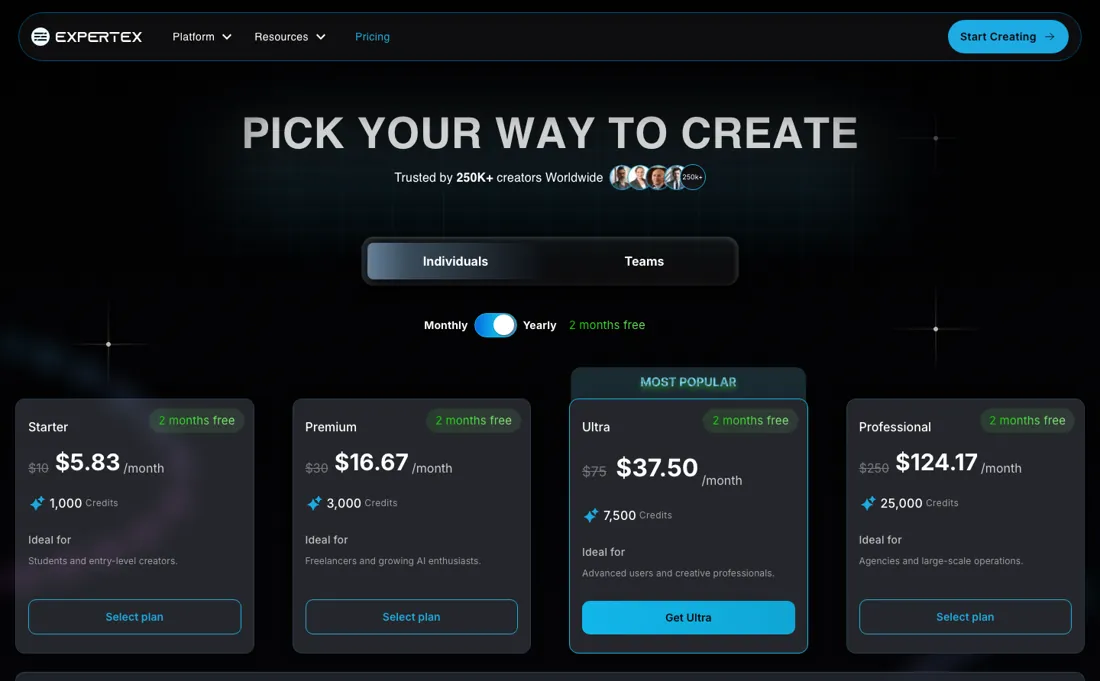
Starter is sold as 65 product photos and 10 short video ads a month on 1,000 credits; at the calculator's own rates that work costs 4,125 credits, four times the allowance. The card numbers only reconcile if each is taken alone, and at roughly 15 credits a photo and 100 a video. The same 4.2x mismatch repeats on every tier, so it is a systematic difference rather than a typo.
Ask which rate governs before you buy, because the calculator will steer you to a plan two rungs above what the card implies. The second thing to price is that this is a credit product with no free tier. Prompt Builder is free; generating is not. And the cheap trials ($1, $2, $5) are three days rather than a month -- enough to test output quality, not enough to test a monthly workflow.
And the fundamental one: AI product photography is judged on whether the output is publishable without a retoucher. Run your own worst product through the trial -- a reflective bottle, a garment with fine texture -- rather than the kind of thing that looks good in every demo.
Watch the video review
The video version of this review, from our YouTube channel.
⚡ Short on time? Watch the 30-second verdict Short.
What ExpertEx does
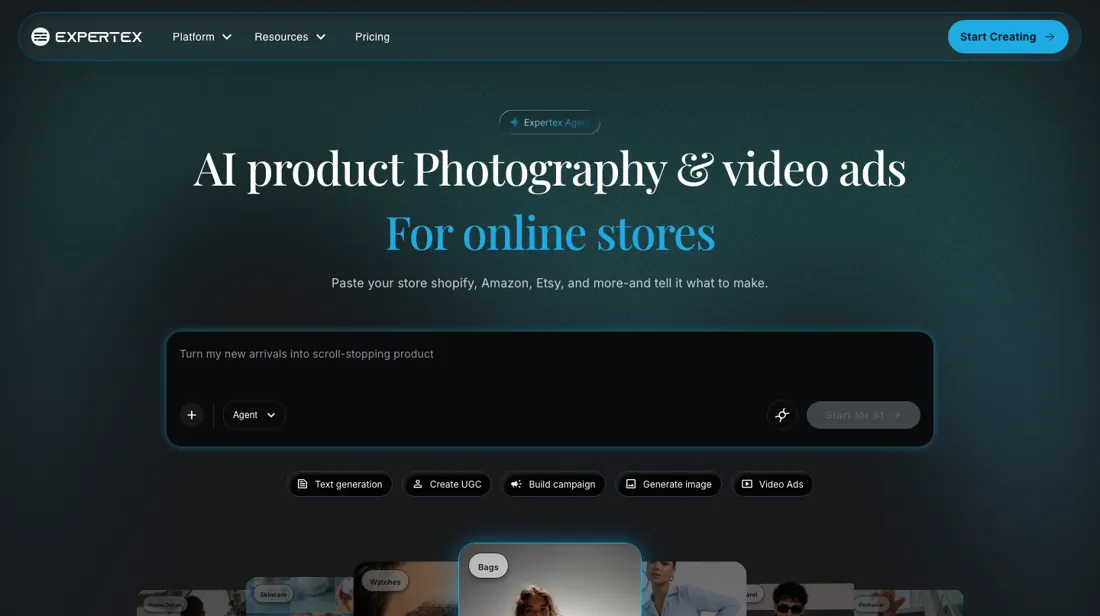
A unified AI studio: chat across multiple models (GPT-4, Gemini), generate images, video and voice, and reuse prompts — multilingual, all in one workspace.
What buyers report about ExpertEx
Hands-on: not tested by usReported by buyers: Trustpilot, read October 2026
Themes from the buyer-review sites listed at the foot of this page, read in October 2026. We have not run ExpertEx ourselves, so this is other buyers' experience rather than ours. We summarise it here because the complaints are usually the part a vendor page leaves out.
- • James Oliver (South Africa, reviewed 8 March 2026, experience dated January 2026) calls it one of the top platforms for AI multimedia and names access to models from many providers. That describes the earlier multi-model product more than the product-photo and video-ad tool sold today; the review does not mention product photos, video ads or credits.
- • Abdo Homs (Syria, 17 October 2025) writes that they did not try the product and questions who buys a premium plan for $1. The company replied on 29 July 2026 that the $1 offer is a limited-time trial with full premium access; the pricing page now presents those $1, $2 and $5 offers as three-day trials.
Where the ratings disagree. Two Trustpilot reviews are the entire public record we found, one five-star and one one-star, and neither is about what the vendor sells now. When we read the platform in August 2026 there were three reviews describing a multi-model chat and generation hub with pricing that was not clearly published; by October one fewer is shown, and the vendor sells AI product photos and video ads on a published credit ladder. Judge the current product with the paid trial, not on this record.
Pages read (October 2026): Trustpilot
When the paid plan is worth it
Read this as a credit ladder, not a feature ladder: every plan includes the same studios and what you buy is volume. Monthly against yearly: Starter is $10 or $7 for 1,000 credits, Premium $30 or $20 for 3,000, Ultra $75 or $45 for 7,500, and Professional $250 or $149 for 25,000. Yearly billing is advertised as two months free, and that holds -- $7 against $10 is 30% off.
Per credit the ladder rewards volume properly. On yearly billing Starter works out at $0.0070 a credit, Premium $0.0067, Ultra $0.0060 and Professional $0.0060. That is a 14% improvement from bottom to top -- real, but not the reason to climb. The actual reason is capability. Reels and Shorts Studio, and the E-commerce Studio that pushes results to your live store, start at Ultra. Full reels cost 2,000 credits and require Ultra or above.
If reels are part of the plan, the tier is chosen for you. Now the arithmetic that decides your tier, and the reason to check it yourself. The calculator on the page charges 25 credits a product photo and 250 a short video ad. At those rates 1,000 credits is forty photos, or four video ads -- while the Starter card advertises 65 photos and 10 video ads. Those two statements cannot both be true, and the same fourfold gap repeats on every tier.
Work out your month in the calculator's currency (photos times 25, videos times 250, reels times 2,000), then ask the vendor which rate is billed. The difference between the two readings is the difference between Starter and Ultra. Two terms that soften the risk of guessing wrong. Credits roll over month to month as long as the subscription is active, so a quiet month is banked rather than lost. Cancelling forfeits the balance, though, which makes the annual plan a commitment of stored value as well as money.
And you can top up on demand or upgrade mid-month without interrupting work, with upgrades prorated immediately. So starting a rung low is recoverable; starting a rung high is not.
How to actually use ExpertEx
There is a free way in that is not a trial: Prompt Builder is free to use before subscribing, and it turns a rough idea into a working prompt. Use it first, because it costs nothing and it tells you whether the tool understands your product category at all. The paid on-ramp is unusual and worth reading carefully: three-day trials at $1 for Premium, $2 for Ultra and $5 for Professional, each carrying real credits (1,000, 2,000 and 5,000) and full access.
Three days is enough to judge output quality and not enough to judge a monthly workflow. So plan what you will generate before you start the clock. And note that it renews unless you cancel before the period ends. The fastest route to something publishable is the store connection rather than one-off generation. The product is built around pasting your store and getting content back. Brand DNA applies your brand's style across everything you make -- one brand on Premium, up to three on Ultra, up to ten profiles on Professional.
On Ultra and above the E-commerce Studio pushes results straight to the live store. The catalog reshoot works in batches: 12 SKUs on Premium, 20 on Ultra, 25 across all stores on Professional. What to test in those three days, in this order. Your hardest product first rather than your easiest. Then a full catalog reshoot batch, to see whether the output is consistent across SKUs. And only then the store push.
Consistency across a catalogue is where AI product photography usually falls down, and it is invisible if you generate one image at a time.
Where this section comes from: our research notes (159 words)
ExpertEx's own pricing page, expertex.ai/pricing, read 10 September 2026 in a browser (the plan block renders client-side and a plain fetch returns an empty shell). Four tiers with their credit allowances and the promotional column beside the regular one: Starter $10 (shown at $7) with 1,000 credits, Premium $20 with 3,000, Ultra $45 with 7,500 and Professional $149 with 25,000, each paid tier carrying a three-day trial priced at $1, $2 and $5.
The page also publishes what a credit buys — 25 credits per product photo, 250 per short video ad and 2,000 per full reel, with reels requiring Ultra or higher — and the per-plan output counts (65, 200, 500 and 1,700 product photos; 10, 30, 75 and 250 short video ads). Yearly billing is marked as two months free. Re-verified 10 October 2026 in a browser on expertex.ai/pricing, including the Teams tab and the four FAQ answers (credit expiry, plan changes, running out mid-month, free trial).
The natural comparison is Poe / ChatGPT — single-model or aggregator chat tools.
Frequently asked questions
Is there a team plan, and what does it cost for five people?
Yes, on a separate Teams tab of expertex.ai/pricing (read in a browser on 10 October 2026). Lite and Growth are priced per seat with a minimum of 5 seats: Lite is $7 a seat a month for 1,000 credits per seat (so at least $35 a month for five), $18 for 3,000 and $30 for 5,000; Growth is $59 a seat a month for 10,000 credits per seat and $115 for 20,000. Ultimate is shown as $3.000 "/seat/month" with "Unlimited seats included" and 500K total team credits; whether that is a flat team price is not confirmed by the page. Yearly billing on the Teams tab is exactly two months free.
What happens to unused credits if I cancel?
According to the pricing FAQ (read 10 October 2026), unused credits roll over month to month while the subscription is active, and you lose them only if you cancel. So spend or export your work before cancelling; a large rolled-over balance is not refunded according to anything the page says.
What if I run out of credits mid-month?
The FAQ says you can top up credits on demand or upgrade a tier, and that work in progress is not interrupted. Upgrades take effect immediately and are prorated; downgrades take effect at your next billing date. The page does not print a price for a top-up, so that cost is not confirmed.
Is this a hands-on review of ExpertEx?
This is a researched assessment, not a hands-on test — where we've used a tool ourselves, we say so explicitly. We name what each tool is good and bad at, and we earn a commission only if you sign up, at no cost to you.
- Buyer reviews on Trustpilot (trustpilot.com/review/expertex.ai), read October 2026.
- Read 2026-08-22 in a live browser on expertex.ai/pricing -- plain fetches return an empty page, so this is the first reading we have of the real ladder.
- A dated screenshot of that pricing page, kept on this site as the receipt.
Others in this category
Reviewed it & productivity tools that share ground with ExpertEx — comparable in what they do, not drop-in swaps:
New reviews, price changes we recorded, and the cost conditions we found. No sponsored placements. Unsubscribe anytime.
This is our researched assessment — not a paid placement. The “Visit” links on this page are affiliate links: we may earn a commission if you sign up, at no extra cost to you, and it never changes our take. How we review →