 Devs.ai Review (2026)
The seat price is the smaller half of the bill.
Visit Devs.ai → Affiliate link — the rest of this page is the honest version, including who should skip it.
Watch the 2-minute review
Same honest take, in video form — from our YouTube channel.
Pricing (2026)
✓ Pricing re-verified 26 Aug 2026
Devs.ai does publish its pricing — on the marketing site at devs.ai/home/pricing, not at the app's /pricing route, which bounces you to a login screen. Free is $0 forever, but Agent Builder and App Builder appear there in "Core" rather than "Full" form, data upload is capped at 2 GB, and workflows, APIs and integrations are marked absent. Personal is $15 per seat / month billed annually or $18 billed monthly; Business is $30 per seat / month annually or $36 monthly; Enterprise is a custom annual contract.
The seat fee is not the whole bill: Personal includes $10 of usage per month and Business $21, with model usage metered on top of the seat. Data upload runs 2 GB, 10 GB, 20 GB and custom across the four tiers. Team governance and collaboration start at Business, while SSO (OpenID/SAML), access control lists, custom connectors and white-labelling are Enterprise-only. Separately, Devs.ai told us by email on 5 August 2026 that organisations upgrading to a paid Personal or Business plan can earn up to $100 in usage credits for completing setup steps: starting a conversation, creating an agent, connecting an integration, deploying an app.
The credits are shared org-wide and do not expire. Enterprise is excluded, and orgs already on a paid plan before July 2026 are not enrolled by default. That last paragraph is the vendor's own statement to us, not something we found published on the pricing page. Plans change — always verify the live price on their site.
What the pricing page doesn’t say
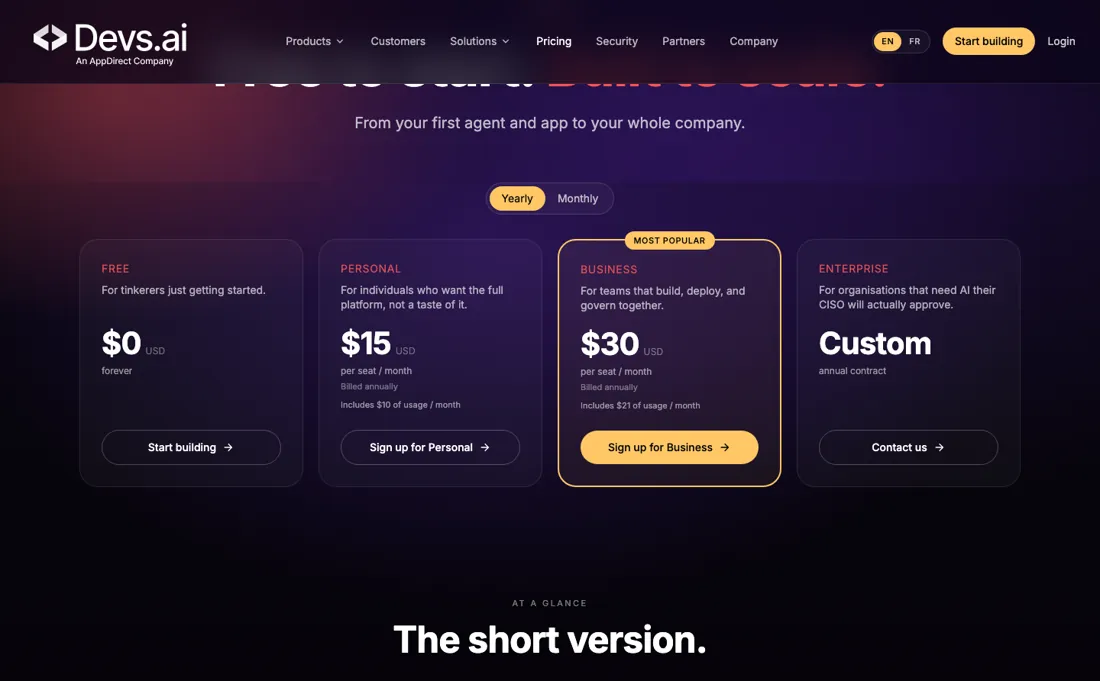
Personal includes $10 of usage a month and Business $21, with model usage metered on top of the seat. The plan cards state the included amount without stating the rate you pay once it runs out — which is exactly the number you need to forecast a real workload. The free plan is a demo rather than a working tier: both builders are limited to "Core", and workflows, APIs and integrations are absent entirely, which is much of what would make the platform useful past a first agent.
And for a product sold on IT governance, the governance controls are the ones you cannot buy with a card — SSO, access control lists and white-labelling sit on the Enterprise tier, behind a custom annual contract.
What Devs.ai does
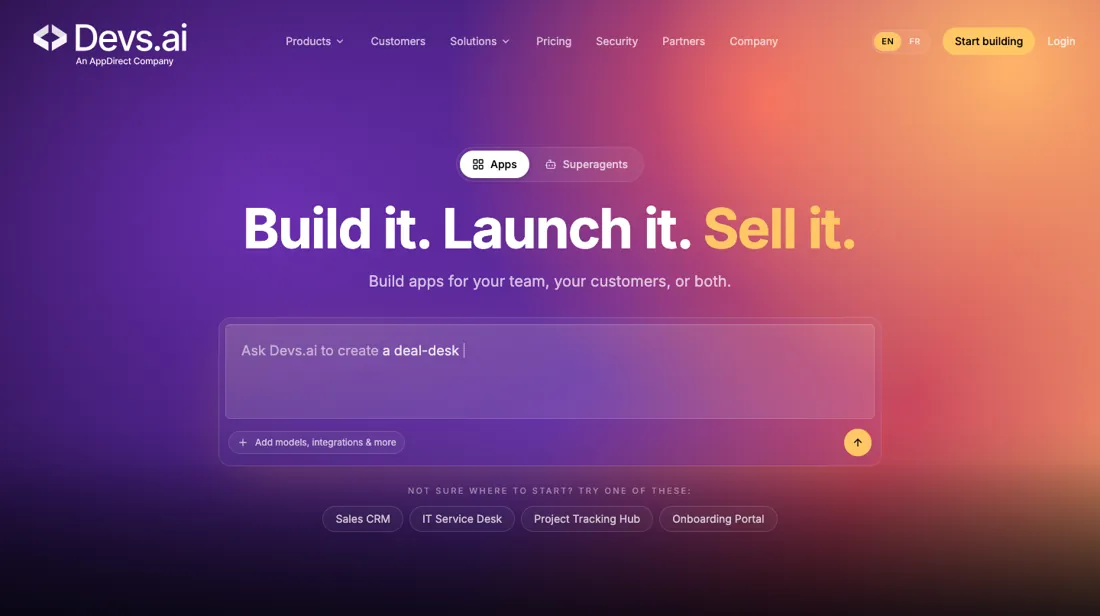
Build and ship AI agents and apps across many models without engineering work. Personal includes $10 of model usage a month and Business $21, metered on top — and the plan cards state the included amount without stating the rate once it runs out.
What buyers report about Devs.ai
Nothing, and we would rather say so than fill the space. We looked for independent user reviews of Devs.ai on the buyer-review sites listed at the foot of this page, read in August 2026, and found none at all. That points to a young product rather than a badly reviewed one, but it does mean there is no crowd verdict to weigh: judge Devs.ai on your own trial, not on anyone's score.
- • The governance that makes it enterprise-ready also has to be configured before you roll it out. Budget that work.
- • Per-seat pricing means a wide rollout costs real money — plan the seat count first.
- • Deeply custom software and complex architecture still need actual developers. This shortens the simple work, not the hard work.
- • The plan cards state the usage included with each seat but never the rate you pay once it runs out, so a real workload cannot be forecast from the pricing page alone.
These four are our own reading of the product and its pricing page. They are not reports from other buyers, because there are none.
When the paid plan is worth it
The seat price is not the bill, and reading it that way understates both tiers. Personal is $15 a seat a month billed annually ($18 monthly) and includes $10 of usage; Business is $30 annually ($36 monthly) and includes $21. So the seat itself is really about $5 on Personal and $9 on Business, with model usage metered on top -- and the included allowance more than doubles while the price merely doubles.
If you expect to use the models at all, Business is closer to Personal than the headline suggests. The free tier is a demonstration rather than a working plan: Agent Builder and App Builder appear in Core rather than Full form, data upload is capped at 2 GB, and workflows, APIs and integrations are marked absent. Anything you would automate needs a paid seat. The real feature lines sit higher up.
Team governance and collaboration start at Business. SSO via OpenID or SAML, access control lists, custom connectors and white-labelling are Enterprise-only -- so if your security review requires SSO, the ladder ends at a custom annual contract regardless of headcount. One thing came from the vendor rather than the page, and we mark it as such. Devs.ai told us by email on 5 August 2026 that organisations upgrading to a paid Personal or Business plan can earn up to $100 in usage credits for completing setup steps.
Those credits are shared org-wide and do not expire, Enterprise is excluded, and organisations already on a paid plan before July 2026 are not enrolled by default. That is their statement to us, not something published on the pricing page, so ask them to confirm it applies to you before counting on it.
How to actually use Devs.ai
Signup is self-serve. Create an account at devs.ai with an email address and a password, verify the address, then create an organization - that organization is what colleagues are invited into, as Member or Admin, so name it for the company rather than for yourself. You land on a homepage where the default chat agent already works and the model is chosen per session. The eye icon in the top right opens a temporary chat that saves no conversation and builds no memory, which is where to try a prompt you do not want kept.
Your own agent starts from Create Agent in the left sidebar, and the documentation suggests letting the AI wizard draft its skills first, then refining that draft. The API is a separate setup, and the step people miss. Keys are created at devs.ai/api-keys with Create new secret key, given a name and permissions. An agent will not answer until you have opened a chat session — the session is what carries the conversation history the agent reads as context.
Distilled from Devs.ai documentation at docs.devs.ai: "Getting started", "Agent Skills" and the API tutorial, together with the pricing page at devs.ai/home/pricing, read 26 August 2026.
Devs.ai vs MindStudio, side by side
Both columns come from the same place: each vendor’s own published pricing, read on the date shown in the sources at the foot of this page. We do not average them into a score.
Both names above are affiliate links: we may earn a commission if you sign up, at no extra cost to you. Neither changes what this table says: both columns come straight from the vendors’ own pricing pages.
The natural comparison is MindStudio or Dify — the agent-builder field — all three meter model usage differently on top of their base price, so compare on the metered layer rather than on the seat fee.
More on Devs.ai
Everything we publish about Devs.ai links back here — the review stays the honest hub:
The ex-banker filter — the same yardstick on every review (how we review): My ex-banker filter is simple: does Devs.ai remove a real cost — time, errors, missed revenue — bigger than what it charges?
Frequently asked questions
What should I weigh before buying IT & Productivity software?
Judge it on evidence rather than adjectives. Look for a published security page, single sign-on and role controls on the plan you would actually buy (they are often gated to higher tiers), a status page with real incident history, and a clear answer on where your data is stored. If the tool will hold anything sensitive, those four answers matter more than any feature comparison.
Is this a hands-on review of Devs.ai?
This is a researched assessment, not a hands-on test — where we've used a tool ourselves, we say so explicitly. We name what each tool is genuinely good and bad at, and we earn a commission only if you sign up, at no cost to you.
- Buyer reviews on Slashdot, which lists no user reviews for it, and platform documentation, read August 2026.
- Re-verified 2026-08-26, read in a live browser session on devs.ai/home/pricing with both billing toggles.
- A dated screenshot of that pricing page, kept on this site as the receipt.
Others in this category
Reviewed it & productivity tools that share ground with Devs.ai — comparable in what they do, not drop-in swaps:
New dossiers, cost-traps we found, and tools that earned a keep — no hype, no sponsored-disguised-as-advice. Unsubscribe anytime.
This is our researched assessment — not a paid placement. The “Visit” links on this page are affiliate links: we may earn a commission if you sign up, at no extra cost to you, and it never changes our take. How we review →