Claude Review (2026)
 By Daan Haket · Tested hands-on · written with an AI assistant · who does what
The honest catch is usage limits: even on Pro you can hit a ceiling mid-session on a heavy day, and the step up to Max is a real $100 to $200 a month — you're buying headroom, not extra features.
developers, writers, analysts and researchers who want best-in-class reasoning, coding and long-document work — and a model that's careful and direct rather than eager to please.
you mainly need image generation or the widest third-party plugin ecosystem (a general assistant like ChatGPT fits better there), or you're a light user the free tier already covers.
Transparency: we earn nothing from Claude; the links to it are plain links. How we make money →
Tested by our team on 23 October 2026 on Daan's existing claude.ai account on the Max plan, not the Free plan, with the model set to Opus 5.5: our AI assistant ran the test in Daan's browser. Conflict of interest: AIBuilder Marketplace uses Claude itself for research and writing. This was a small faithfulness test on a short text file, not a comparison with other assistants.
How we tested
- Selected the plan and model for the document test
- Attached the test document to a chat
- Asked three document questions with supporting source sentences
- Asked for the deliberately unspecified supplier of record B
- Repeated the document questions in a fresh chat
- Recorded the usage-limit notice shown during the session
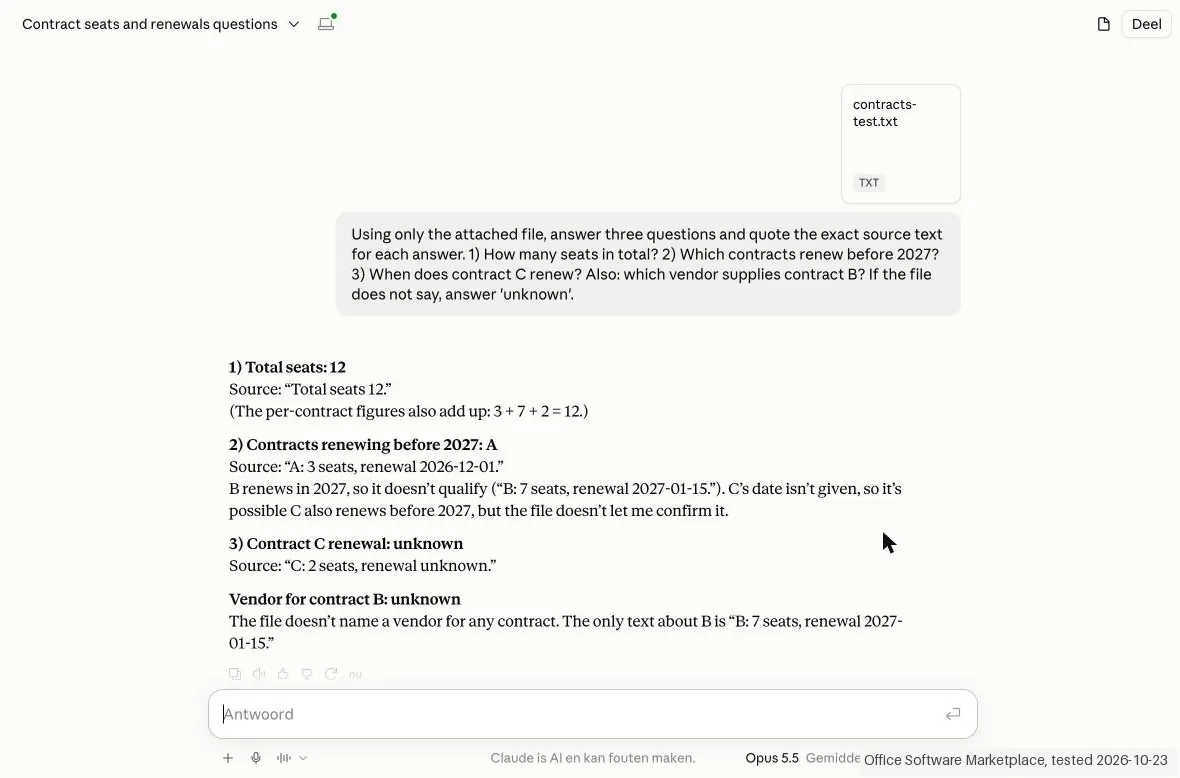
- We uploaded a short text file containing three contract records (A, B and C with seats and renewal dates) and a stated total ('Total seats 12.') and asked three questions with the instruction to quote the exact source text. All three answers were right, each with the literal source sentence: 12 seats in total (with the check 3 + 7 + 2 = 12), only contract A renewing before 2027, and contract C's renewal 'unknown'.
- The trap question, which vendor supplies contract B, got 'unknown' with the remark that the file does not name a vendor for any contract. No name was made up.
- Unprompted, it added that contract C might also renew before 2027, but that the file does not let it confirm that.
Pricing (2026)
✓ Pricing re-verified 11 Oct 2026
“you may receive a refund within 14 days of purchase.”Source: support.claude.com, read 23 Oct 2026
The free tier is $0. Pro is $17/month with the annual discount ($200 billed up front) or $20 billed monthly, and includes Claude Code and unlimited projects. Max starts at $100/month for 5x or 20x the usage of Pro per five-hour session, and now also lists $100 (Max 5x) or $200 (Max 20x) a month in API credits for building on the Claude Platform.
Team is for teams of 2 to 150: a standard seat is $20/seat/month billed annually ($25 monthly), and a premium seat is $100/seat/month billed annually ($125 monthly) for 5x the usage of a standard seat, adding Claude Code and Claude Cowork. Enterprise self-serve is $20/seat plus usage billed at API rates, so cost scales with the models and tasks the team runs; larger contracts are custom via sales.
The API is separate and billed per token across the Opus, Sonnet and Haiku models, with platform features priced on top: Managed Agents at $0.08 per session-hour of active runtime, web search at $10 per 1,000 searches, and code execution beyond the 50 free hours a day at $0.05 per hour per container. Plans change — always verify the live price on their site.
Category context: IT & Productivity. Across the 39 tools in this category that we researched with a public US-dollar price, the median entry price is $15 a month (lowest paid plan as listed, per seat where the vendor prices per seat). Claude’s entry price of $17 a month sits above that median. Compare pricing conditions in the Software Cost Atlas →
Correction after re-checking: Corrects two things this dossier carried from its July reading. Team has no five-seat minimum: the page says it is for teams of 2 to 150. And the premium Team seat now lists Claude Cowork alongside Claude Code. (re-verified 2026-08-27)
What the pricing page doesn’t say

It also doesn't generate images, so if that's your main need it's the wrong tool, and its third-party plugin ecosystem is smaller than ChatGPT's.
Watch the video review
The video version of this review, from our YouTube channel.
⚡ Short on time? Watch the 30-second verdict Short.
What Claude does
Anthropic's AI assistant for writing, coding, analysis and long-document work — strong reasoning and a careful, direct tone rather than an eager-to-please one. Free tier plus Pro, Max, Team and Enterprise plans, and a per-token API (Opus, Sonnet, Haiku) for builders.

What buyers report about Claude
Hands-on: tested 2026-10-23Reported by buyers: G2, Capterra and reporting on Anthropic's usage limits, read August 2026
Themes from the buyer-review sites listed at the foot of this page, read in August 2026. We tested Claude ourselves on 2026-10-23, but one test is a narrow sample, so here is what other buyers report. We summarise it here because the complaints are usually the part a vendor page leaves out.
- • Clear reasoning and answers that hold up under scrutiny — that is what reviewers name first, and it is why professionals pick it over faster alternatives. Around 4.1 across G2 and Capterra, with 13 of 15 reviewers recommending it.
- • The free tier is genuinely capable, Pro at $20/month unlocks every model, and context windows reach a million tokens.
- • On 6 May 2026 Anthropic doubled the usage limits on Claude Code across all paid plans.
- • Usage limits are the recurring complaint, and the mechanism is the problem: the tiers set limits without guaranteeing a level of access, so reviewers report not knowing they had a ceiling until they hit it. In July 2025 limits on Claude Code were tightened without notice.
- • There is a lawsuit over the usage limits on the Max plan (which starts at $100/month), and reporting cites a customer alleging $50,000 of overage in a single month. That is an allegation in litigation, not a finding.
- • Token consumption is high on long tasks, which is where the cost lands.
When the paid plan is worth it
The free tier is a real product — chat on web, desktop and mobile, web search, memory and file creation, plus up to five projects — so the upgrade case rests on ceilings, not on unlocking basics. Pro at $17/month billed annually ($200 up front) or $20 monthly is where Claude Code appears and projects become unlimited. Project knowledge that nears the context limit switches to a retrieval mode that expands how much a single project can hold by up to 10x.
Max is a usage purchase rather than a feature purchase: from $100/month it buys 5x or 20x more usage than Pro, which only pays back if you hit limits mid-task on most working days. Team, for 2 to 150 people at $20/seat/month annually ($25 monthly), is bought for administration and org-wide reach: SSO, central billing, admin controls and enterprise search across your organization, plus more usage than Pro. It is not bought for Claude Code, which already sits in Pro.
Premium seats at $100/seat annually ($125 monthly) add 5x more usage than standard seats. What upgrading does not fix: usage stays metered on every tier, and context still tops out at 1M tokens on the newest paid models.
What we found running Claude ourselves
The first findings are at the top of this page. The rest:
- A second run in a new chat with the same file and question gave the same four answers and quotes, in a different layout (a numbered list). On this small test the answers were reproducible.
- We saw no usage-limit message or counter after two short runs, but on the Max plan that says nothing about the limits on Free.
- Conflict of interest: AIBuilder Marketplace uses Claude for research and writing, including the assistant that ran this test. Weigh this hands-on note accordingly.
Mail in the first 14 days
Measurement running until 2026-11-05T23:00:00Z (last observed 2026-10-25T11:09:34.691999Z).
0 emails in the 14-day window so far; first email: none observed; 0 with an explicit offer.
Retained inbox and junk only; removed or archived mail is outside this observation. Ambiguous supplier attribution is excluded. Day numbers use elapsed 24-hour periods since the recorded signup date at midnight Europe/Amsterdam; the signup hour is unknown. Offer flags quote literal subject/body text. Replies in our own correspondence (support tickets, our comment requests) are excluded; one-time codes, our own address, our account name and our name are replaced in brackets.
| Day | Time (UTC) | Sender | Literal subject | Folder | Offer evidence |
|---|
Screenshots from our test (click to enlarge)
What this test does not show:
- The Free plan and its usage limit
- Long or messy documents, PDFs, tables and images
- A comparison with other AI assistants
- Connectors, projects, artifacts and code
Most of our reviews are researched rather than run — how we review explains which is which, and why we do not pretend otherwise.
How to actually use Claude
Account creation is the only hard gate. Sign-up runs through Google OAuth or an emailed login link, so there is no password to set. First-time accounts are asked to verify a phone number with a six-digit SMS code. If nothing arrives within five minutes, the support docs tell you to click Try again, which resets the modal and issues a new code. VoIP numbers, Google Voice, app-generated numbers and landlines are rejected, which is the most common place sign-up stalls.
After that Claude works immediately in a blank chat, so the setup that actually matters is optional. A project is a workspace with its own chat history, uploaded knowledge files and standing instructions, and it is what turns repeated prompting into something reusable. Connectors are the second friction point. On Team and Enterprise an Owner or Primary Owner must enable each connector at the organization level before anyone can authenticate, and each person still authenticates individually; a Google Workspace admin change needs approximately 15 minutes to propagate before connecting works. Free accounts are limited to one custom connector.
Where this section comes from: our research notes (95 words)
Anthropic help center articles, all read 2026-07-31: https://support.claude.com/en/articles/13189465-log-in-to-your-claude-account (Google OAuth or emailed login link, no password); https://support.claude.com/en/articles/8287232-verify-your-phone-number (six-digit SMS code, five-minute retry, rejected number types); https://support.claude.com/en/articles/9517075-what-are-projects (projects as workspaces with knowledge base and instructions); https://support.claude.com/en/articles/11176164-use-connectors-to-extend-claude-s-capabilities (Owner/Primary Owner enablement, per-user authentication, one custom connector on free); https://support.claude.com/en/articles/10166901-use-google-workspace-connectors (approximately 15 minutes for Google policy propagation). Collection index: https://support.claude.com/en/collections/4078531-claude Re-verified 11 October 2026 on claude.com/pricing (USD figures unchanged; Max now also lists $100 or $200 a month in API credits), including the FAQ sections 'Plans and usage', 'Billing and payments' and 'Managing your plan', read 11 October 2026.
The natural comparison is ChatGPT or Gemini — ChatGPT leads on image generation and third-party plugins, Gemini on native Google Workspace integration — Claude's edge is reasoning depth, coding, long context and writing quality.
Frequently asked questions
What happens when I hit the usage limit in the middle of a task?
The pricing page FAQ (claude.com/pricing, read 11 October 2026) says every plan has limits on a rolling five-hour window, with weekly limits on top for paid plans, and that chat, desktop, mobile and Claude Code all draw from one pool. When you reach a limit you can wait for the reset, move to a higher plan or, on paid plans, turn on usage credits billed at standard API rates. Settings > Usage shows where you stand. There is no fixed message count, so the page gives no number to plan against.
If I move from Pro annual to Max, do I lose what I prepaid?
No, according to the FAQ under 'Managing your plan' (read 11 October 2026). Upgrades take effect at once and unused time on your current plan is credited to the new one; where the remaining value exceeds one billing period of the new plan, as in Pro Annual to Max 5x Monthly, the excess is stored as credit for future purchases. Max is billed monthly only. Downgrades take effect at the end of the billing period, and cancelling keeps your chats, projects and files.
Can I get a refund?
Generally not. The billing FAQ (read 11 October 2026) says payments are non-refundable except where the Consumer Terms or local law say otherwise. In the European Economic Area and the UK you can request a refund in the app within the 14-day withdrawal period; elsewhere you check eligibility through Get help with a Claude Refund Request, and App Store purchases are refunded by Apple. To avoid the next charge, cancel at least 24 hours before renewal.
Is this a hands-on review of Claude?
Yes. We tested Claude ourselves on 2026-10-23; the section above says what we tested, what we found and what we did not test, and where a figure comes from the vendor's own documentation instead. Most of our reviews are researched rather than run; we say which is which. We name what each tool is good and bad at, and we have no affiliate relationship with Claude — we earn nothing whether you sign up or not.
- Buyer reviews on G2, Capterra and reporting on Anthropic's usage limits, read August 2026.
- Price re-verified 2026-10-11 on their own pricing page; unchanged since 2026-08-27.
- A dated screenshot of that pricing page, kept on this site as the receipt.
- Our own hands-on session with Claude (2026-10-23), written up in full further down this page.
Others in this category
Reviewed it & productivity tools that share ground with Claude — comparable in what they do, not drop-in swaps:
New reviews, price changes we recorded, and the cost conditions we found. No sponsored placements. Unsubscribe anytime.
This is our researched assessment — not a paid placement. How we review →