Proton Drive Review (2026)
 By Daan Haket · Tested hands-on · written with an AI assistant · who does what
End-to-end encryption is the point and the price. Throughout this review we weigh it against Dropbox.
privacy-conscious individuals and businesses that want genuinely end-to-end-encrypted storage from a Swiss provider, ideally as part of the wider Proton suite.
your workflow lives on deep integrations, shared-drive collaboration and full-text search (mainstream clouds do that better), or you'd never set up account recovery.
Transparency: the “Visit” links on this page are affiliate links — we may earn a commission if you sign up, at no extra cost to you. No vendor can pay for a better review or verdict. How we make money →
A new free account, used in the web app in Chrome. We uploaded four files we made ourselves with known SHA-256 checksums: a 9.6 KB text note, 1 MB and 8 MB files of random bytes, and a small text file named 'naam met spaties en é.txt' to test spaces and an accented letter. We created a public link for the 1 MB file, opened it in a separate browser that was not signed in to Proton, then downloaded all four files again and compared them byte for byte with the originals.
- All four files came back identical: the same size and the same SHA-256 checksum as the originals, and the file name with spaces and an accented letter was unchanged, byte for byte.
- The new account started at 2 GB, not 5 GB. A pop-up offered a 3 GB welcome bonus, and after we uploaded files and created a share link the meter showed 5 GB. The same pop-up still said '29 days left to claim' afterwards.
- The public link opened for a visitor without a Proton account and offered the file for download. The decryption key is the part of the link after the '#': the same link without it showed a password prompt instead, so a chat app or mail client that cuts off that part leaves the recipient stuck.
Pricing (2026)
✓ Pricing re-verified 16 Oct 2026
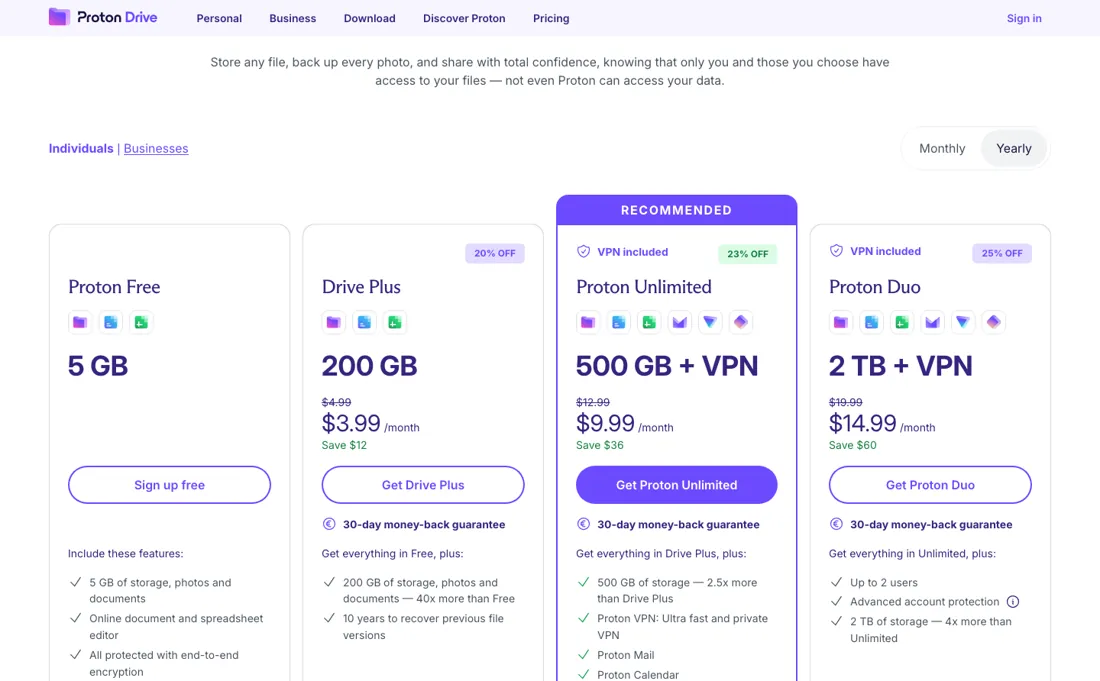
| Plan | Price | What you get |
|---|---|---|
| Proton Free | $0 | 5 GB |
| Drive Plus | $3.99/mo billed yearly | 200 GB — the only tier that is storage on its own |
| Proton Unlimited | $9.99/mo billed yearly | 500 GB plus the VPN, Mail and Calendar |
| Proton Duo | $14.99/mo billed yearly | 2 TB across two users |
| Proton Family | $23.99/mo billed yearly | 3 TB, up to six users |
| Drive Professional | $7.99 per user/mo | for teams, 1 TB each |
Proton Free gives 5 GB. Drive Plus is $3.99 a month for 200 GB, marked 20% off $4.99 and billed at $47.88 every twelve months. Proton Unlimited is $9.99 for 500 GB and folds in the VPN, Mail and Calendar, billed at $119.88 a year. Proton Duo is $14.99 for 2 TB across two users at $179.88 a year, and Proton Family $23.99 for 3 TB and up to six.
Teams get Drive Professional at $7.99 per user a month for 1 TB each. The page carries its own currency selector with CHF, EUR and USD, so these are the US default rather than a conversion. The thing worth seeing in that ladder: Drive Plus is the only tier that is storage on its own — every step above it bundles the rest of Proton, so you are buying a suite the moment you need more than 200 GB. Plans change — always verify the live price on their site.
Category context: IT & Productivity. Across the 36 tools in this category that we researched with a public US-dollar price, the median entry price is about $15 a month (lowest paid plan as listed, per seat where the vendor prices per seat). Proton Drive’s entry price of $3.99 a month sits below that median. Compare pricing conditions in the Software Cost Atlas →
What the pricing page doesn’t say
Because Proton can't read your files, there's no server-side search inside documents. Previews and third-party integrations are more limited than Google Drive or Dropbox, and losing your credentials without recovery set up means losing data — by design. You trade convenience for the mathematical guarantee that nobody, including Proton, can look inside.
Watch the video review
The video version of this review, from our YouTube channel.
⚡ Short on time? Watch the 30-second verdict Short.
What Proton Drive does
End-to-end encrypted cloud storage from a Swiss provider. Because Proton cannot read your files there is no server-side search inside documents, integrations are thinner, and losing your credentials without recovery loses the data.
What buyers report about Proton Drive
Hands-on: tested 2026-10-09Reported by buyers: Cloudwards, Reddit and storage-review sites, read August 2026
Themes from the buyer-review sites listed at the foot of this page, read in August 2026. We tested Proton Drive ourselves on 2026-10-09, but one test is a narrow sample, so here is what other buyers report. We summarise it here because the complaints are usually the part a vendor page leaves out.
- • End-to-end encrypted storage from a Swiss provider with 5 GB free — for privacy-sensitive files it is the reference point.
- • Download speeds are excellent, and it bundles into the Proton Unlimited subscription alongside Mail, VPN and Pass.
- • Upload speed is the recurring complaint. On a 400 Mbps line reviewers measure sustained uploads of 30-50 Mbps, and small files are worse because encryption overhead is per file. One reviewer on symmetrical gigabit reports 93.6 KB/s.
- • There is no search function in the Android or iOS apps — only on the web. For a storage product that is a real gap.
- • Mobile app bugs are reported.
- • The privacy costs money, and reviewers who do not need it say so.
Two people should never buy two accounts
Proton publishes six plans and the per-gigabyte rate is not the story in any of them — the seat count is. Read on their own site in euros from a Dutch address, with annual billing on. Drive Plus is 200 GB at €3.99 a month, and Proton Unlimited 500 GB at €9.99. Duo is 2 TB for up to two users at €14.99, and Family 3 TB for up to six at €23.99.
Drive Professional is €7.99 per user for 1 TB each. Free is 5 GB. The sharpest finding sits between Unlimited and Duo. Two people buying an Unlimited account each pay €19.98 a month and get 500 GB apiece — one terabyte between them. Duo is €14.99 for the pair and gives them two terabytes. That is 25% less money for twice the storage, and there is no scenario in which two Unlimited accounts is the right purchase.
If you are a couple, a co-founder pair or two people sharing a household bill, this is the entire decision. The same shape repeats one step up. Three separate Unlimited accounts cost €29.97; Family covers up to six people for €23.99. So from three users onward Family is cheaper than buying individually, and it stays cheaper all the way to six. At that point it works out at €4.00 per person, close to what Drive Plus alone costs, except that everyone also gets VPN, Mail, Calendar and Pass.
That makes Drive Professional the plan to look at hardest. At €7.99 per user it is exactly double Family's per-head cost at six people, and what the doubling buys is the business wrapper — team administration — rather than storage or features. For a six-person company that is €47.94 a month against €23.99. Worth it if you need central control of accounts and offboarding; a straightforward overpayment if you are six people who trust each other.
One last thing the pricing page will not point out. The monthly penalty is not uniform. Drive Plus, Family and Professional all cost almost exactly 25% more billed monthly. Unlimited costs 30% more, and Duo 33% more — and those are the two plans most people end up on. If you are going to pay monthly, know that you are paying the steepest surcharge precisely where the surcharge is worst.
Every plan carries a 30-day money-back guarantee, so the annual commitment is less binding than it looks.
Our monthly capture read this vendor's pricing page in July 2026 and again in August 2026, and the amounts were the same both times. We keep watching — the registry records what moves.
What we found running Proton Drive ourselves
The first findings are at the top of this page. The rest:
- Setting an expiry date and a password on a link is available on the free plan; we opened both settings but did not save them.
- Not tested: the desktop and mobile apps, sync, photo backup, version history, sharing with another Proton user, and large uploads.
Most of our reviews are researched rather than run — how we review explains which is which, and why we do not pretend otherwise.
How to actually use Proton Drive
Set up account recovery before you upload anything. Proton cannot read your files, which is the product, and the direct consequence is that losing your credentials without a recovery method means losing the data — by design, with no support ticket that fixes it. This is the one step that is genuinely irreversible if skipped. Then test the trade before you commit. Because encryption is end-to-end there is no server-side search inside your documents, previews are more limited than Google Drive or Dropbox, and third-party integrations are thinner.
Put a realistic working folder in the free 5 GB and try to find something in it the way you normally would. If that works for you, everything else here is arithmetic; if it does not, no tier fixes it. Count the people before you pick the plan, because that is what the ladder is built on: one person on Plus or Unlimited, two on Duo (never two Unlimited accounts), three to six on Family, and Professional only if you need central administration.
Check the currency switch too — the page serves CHF, EUR and USD, and the figures above are the euro ones. Every plan has 30 days' money back, so the annual rate is the sensible default once the plan is right.
Where this section comes from: our research notes (180 words)
Proton's own Drive pricing page, proton.me/drive/pricing, read twice: on 26 August 2026 over a US connection (the figures in our text) and again on 10 September 2026 from a Netherlands exit. The second reading confirms what the review says about the currency selector — from the Netherlands the same page serves EUR with identical numerals: Drive Plus 200 GB at €4.99 struck through to €3.99 a month, billed €47.88 every twelve months; Proton Unlimited 500 GB plus VPN at €12.99 to €9.99, billed €119.88; Duo at €19.99 to €14.99, billed €179.88; Family at €29.99 to €23.99.
So these are per-region list prices rather than a conversion, exactly as the review states. Both readings were taken on the Individuals view with yearly billing. Re-read 16 October 2026 on the same page with the currency selector set to USD, Individuals view, yearly billing: Drive Plus $4.99 struck through to $3.99 a month, billed $47.88 every 12 months; Unlimited $12.99 to $9.99, billed $119.88; Duo $19.99 to $14.99, billed $179.88; Family $29.99 to $23.99; Drive Professional $9.99 to $7.99 per user. All unchanged.
Proton Drive vs Tresorit, side by side
Where a vendor publishes a price, its column shows the entry price we read and when; where it does not, the column says so rather than filling in a figure from elsewhere. We do not average them into a score.
Both names above are affiliate links: we may earn a commission if you sign up, at no extra cost to you. Neither changes what this table says.
The natural comparison is Tresorit or Google Drive — Tresorit is the enterprise E2EE peer; Google Drive is the convenience default — Proton wins on suite value per euro for individuals. Weigh it against Dropbox on the job you actually need done.
Frequently asked questions
What does Proton Drive cost?
Read on 17 August 2026 from a Dutch address, so in euros: Free gives 5 GB; Drive Plus is €3.99 a month on annual billing (€47.88 a year) for 200 GB; Proton Unlimited is €9.99 (€119.88) for 500 GB plus VPN, Mail, Calendar and Pass. The page switches between CHF, EUR and USD, so your figure depends on where you buy.
Which plan makes sense if two of us need the storage?
Proton Duo, which our previous write-up missed entirely: 2 TB shared across up to 2 users at €14.99 a month on annual billing (€179.88 a year), against €9.99 for Unlimited's 500 GB for one. For a household of more, Family gives 3 TB across up to 6 users at €23.99. For a business it is Drive Professional at €7.99 per user for 1 TB each.
Is the free tier usable?
It is 5 GB, which is enough to try the encryption and the document editor and not much else — a phone's photo roll will fill it. What you do get free is the full end-to-end encryption and the online document and spreadsheet editor, so it works as a genuine trial of the privacy model rather than a crippled demo.
Is this a hands-on review of Proton Drive?
Yes. We tested Proton Drive ourselves on 2026-10-09; the section above says what we tested, what we found and what we did not test, and where a figure comes from the vendor's own documentation instead. Most of our reviews are researched rather than run; we say which is which. We name what each tool is good and bad at, and we earn a commission only if you sign up, at no cost to you.
- Buyer reviews on Cloudwards, Reddit and storage-review sites, read August 2026.
- Read 2026-08-26 over a US connection and re-read 2026-10-16 with USD selected, on proton.me/drive/pricing, Individuals view with yearly billing.
- A dated screenshot of that pricing page, kept on this site as the receipt.
- Our own hands-on session with Proton Drive (2026-10-09), written up in full further down this page.
Others in this category
Reviewed it & productivity tools that share ground with Proton Drive — comparable in what they do, not drop-in swaps:
New reviews, price changes we recorded, and the cost conditions we found. No sponsored placements. Unsubscribe anytime.
This is our researched assessment — not a paid placement. The “Visit” links on this page are affiliate links: we may earn a commission if you sign up, at no extra cost to you, and it never changes our take. How we review →