CloudTask Review (2026)The $299 Deposit Is the Small Part
 By Daan Haket · Researched and written with an AI assistant · who does what
The $299 is the honest part and also the small part: their FAQ calls it a one-time deposit to start a search, denies any monthly platform fee, and says it goes toward your first placement.
companies hiring GTM roles — SDRs, BDRs and similar — who want LATAM talent without setting up their own payroll and compliance in another country, and who value the 24-month replacement guarantee.
you only need one hire ever, where Direct Hire's one-time 20-30% fee is cleaner than a managed monthly rate; also skip it if you cannot get the all-in monthly rate in writing before you commit.
Transparency: the “Visit” links on this page are affiliate links — we may earn a commission if you sign up, at no extra cost to you. No vendor can pay for a better review or verdict. How we make money →
Pricing (2026)
✓ Pricing re-verified 8 Oct 2026
Two hiring models, both published, plus one deposit. A one-time $299 deposit starts your search — asked “Do you charge a monthly platform fee?” their FAQ answers “No. There is a one-time $299 deposit to start your search. That is the only fee outside the models above.” — and the deposit applies toward your buyout or your first placement. Direct Hire costs 20% to 30% of first-year base salary, paid once and quoted per role, with a 6-month replacement guarantee (one replacement, same job description) and US W2 employment available.
Managed Staffing is billed as one all-in monthly rate per person covering salary, compliance, payroll and support — that rate is not published, and it is the number that decides what this costs. It carries a 24-month replacement guarantee with replacements not capped, and time and activity tracking on by default, which the hire agrees to before matching and you can switch off when you post the role.
Full pricing notes (2 more paragraphs)
For roles that create demand — outbound SDRs, BDRs, demand generation and full-cycle AEs — Managed Staffing runs on a six-month minimum term; Direct Hire has no minimum term. Converting a managed hire to direct employment is possible, but their FAQ makes it subject to a conversion fee and a notice period and publishes neither. Commissions and bonuses you add are separate from the all-in monthly rate.
Health and equipment benefits are available on request on Managed Staffing only.
Plans change — always verify the live price on their site.
Category context: HR & People. Across the 13 tools in this category that we researched with a public US-dollar price, the median entry price is $14 a month (lowest paid plan as listed, per seat where the vendor prices per seat). Compare pricing conditions in the Software Cost Atlas →
What the pricing page doesn’t say
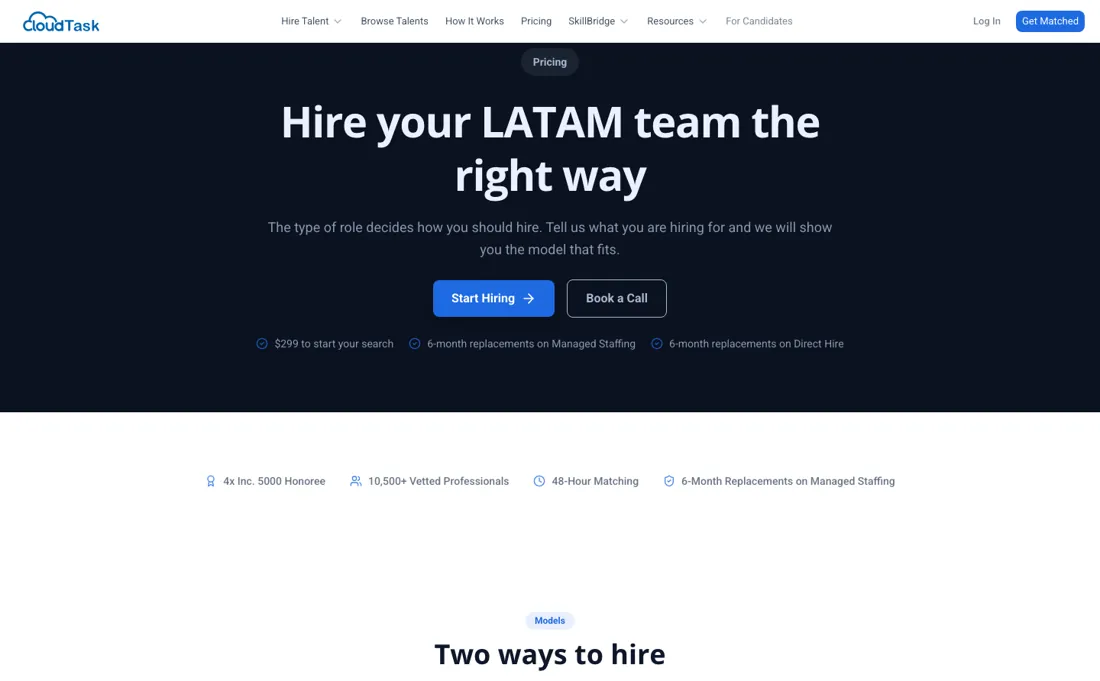
What you will actually spend is the all-in monthly rate per hire, and that figure appears nowhere on the pricing page — you get it after you talk to them, once you are already invested in the process. Work out before you start what a comparable LATAM salary is on your own, so you can see what the managed layer costs on top. The exit is worth reading twice too.
You can convert a managed hire onto your own payroll, but CloudTask's FAQ attaches a conversion fee and a notice period to that and publishes neither. So the price of keeping the person is a number you cannot check in advance.
Watch the video review
The video version of this review, from our YouTube channel.
What CloudTask does
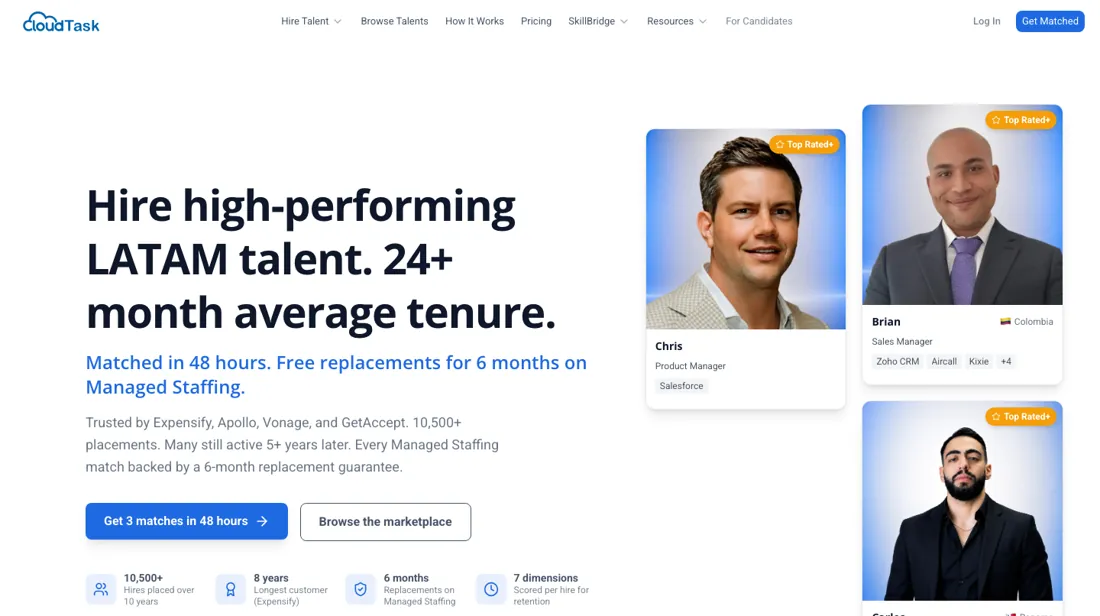
Managed marketplace for LATAM go-to-market hires — SDRs, BDRs and similar — with payroll and compliance handled. Direct Hire instead costs 30% of first-year salary.
What buyers report about CloudTask
Hands-on: not tested by usReported by buyers: Clutch, TrustRadius and Trustpilot, read August 2026, Trustpilot October 2026
Themes from the buyer-review sites listed at the foot of this page, read in August 2026, Trustpilot October 2026. We have not run CloudTask ourselves, so this is other buyers' experience rather than ours. We summarise it here because the complaints are usually the part a vendor page leaves out.
- • On Clutch, the screening is what clients credit: reviewers describe candidates who fit the role and the culture rather than a CV pile, and say the relationship did not stop at the placement.
- • Delivery and project management come up in most Clutch reviews — meeting dates, staying organised and being reachable while a search is running.
- • Several Clutch clients report measurable outcomes on the sales side, at project values mostly in the $10,000–$49,999 band, with some engagements above $50,000.
- • On Trustpilot (4.4 across 21 reviews, read October 2026) clients who hired outbound SDRs, account executives and support reps describe vetted candidates who already knew the tools their business runs on, and one says his two hires came in at a rate he calls incredible.
- • The absence of criticism is itself the finding: across all thirteen Clutch reviews, clients name no area for improvement at all. A review set with no negatives is a fact about the collection method, not about the vendor.
- • The one concrete caution comes from the freelancer side on TrustRadius: placements here are long-term and typically take days to weeks to come through, so it is the wrong platform for anyone who needs a fast, short engagement.
- • TrustRadius reviewers also ask for better communication and a better interface, and one asks for more freelancers on the supply side.
- • The one negative Trustpilot review, from September 2026, comes from the candidate side: a job seeker who did the interviews and videos describes two to three months between promised replies and a profile that was never updated. Trustpilot also notes that CloudTask has not replied to negative reviews.
Where the ratings disagree. The public record is too thin and too old to lean on, and part of it is not even about this product. Clutch shows thirteen reviews at 5.0, clustered in 2022 and 2023. TrustRadius shows nine ratings with four written reviews, all from January 2023 and most flagged as incentivized — and at least two of those four describe something else entirely (remote printing with chip-based ID cards), so that entry is contaminated. Nothing current exists on either platform. Ask CloudTask for references you can call from the last twelve months rather than reading the scores. Trustpilot looks fresher but is not stronger: 20 of its 21 reviews fall in the last twelve months, at least 15 were posted between 27 July and 2 August 2026, several describe experiences from months earlier, and several come from placed candidates rather than paying clients. Trustpilot itself notes the company has not invited customers recently, so the reviews may not be representative.
Pages read (August 2026, Trustpilot October 2026): Trustpilot
When the paid plan is worth it
Read the pricing page before you budget, because the recurring cost is not where the old headline put it. The $299 is a one-time deposit to start your search: asked whether they charge a monthly platform fee, their FAQ answers no, and says the deposit applies toward your buyout or first placement. The figure that actually decides the sum is the one they do not publish -- the all-in monthly rate per person on Managed Staffing, covering salary, compliance, payroll and support.
Ask for it in writing for the exact role and seniority before you compare anything else. The two models buy different things rather than more of the same. Direct Hire is 20% to 30% of first-year base salary, quoted per role and paid once, with a six-month replacement guarantee and US W2 employment available; you keep payroll, compliance and management. Managed Staffing runs a 24-month guarantee with replacements not capped, and CloudTask holds the relationship: its FAQ describes the hire as a contractor engaged through CloudTask under its Vendor of Record model, not your employee.
Neither removes the exit cost: converting a managed hire onto your own payroll is possible, but the FAQ attaches a conversion fee and a notice period and publishes neither. And for outbound sales roles Managed Staffing carries a six-month minimum term, so a hire that does not work out is replaced, not simply ended.
How to actually use CloudTask
There is no software to set up here; the sequence is a hiring process with four documented steps. You submit role requirements through a short form -- role type, team size, tools you use, budget -- with no job description and no recruiter call beforehand. CloudTask returns a shortlist of up to three vetted LATAM candidates within 48 hours, and sends a second shortlist if none of the first three fit.
You interview and choose on your own timeline. After the hire CloudTask handles compliance, contracts, payroll and onboarding coordination, with check-ins at day 7, day 30 and day 60. A $299 deposit starts the search; their pricing page calls it one-time and not a subscription, and says it applies toward your buyout or first placement. One default to settle up front: Managed Staffing hires carry time and activity tracking switched on, agreed by the candidate before matching, and you can turn it off when you post the role.
Distilled from CloudTask's own How It Works page (https://www.cloudtask.com/how-it-works) and pricing page (https://www.cloudtask.com/pricing), both fetched and hashed 19 August 2026. Re-read 8 October 2026: the pricing page (https://www.cloudtask.com/pricing) and the FAQ (https://cloudtask.com/faq/), which is where the six-month minimum term on Managed Staffing for outbound sales roles, the conversion fee and notice period, the contractor (Vendor of Record) status of managed hires and the separate commissions are stated.
CloudTask vs Deel, side by side
Where a vendor publishes a price, its column shows the entry price we read and when; where it does not, the column says so rather than filling in a figure from elsewhere. We do not average them into a score.
Both names above are affiliate links: we may earn a commission if you sign up, at no extra cost to you. Neither changes what this table says.
The natural comparison is Deel — the comparison worth doing, because they solve overlapping problems from opposite ends. Deel publishes its floors and handles employment for people you already found; CloudTask finds the people and wraps employment around them, but does not publish the all-in rate. Decide by whether your bottleneck is sourcing or paperwork, then insist on the missing number.
Frequently asked questions
Can I end a Managed Staffing hire after a couple of months?
Not for every role. CloudTask's FAQ (read 8 October 2026) says Managed Staffing runs on a six-month minimum term for roles that create demand: outbound SDRs, BDRs, demand generation and full-cycle AEs. Direct Hire has no minimum term; you pay the one-time 20% to 30% fee when the candidate accepts. For other roles on Managed Staffing the FAQ names no minimum term, so that is not confirmed either way.
Can I move a managed hire onto my own payroll later, and what does it cost?
Yes, at a price nobody publishes. The FAQ (read 8 October 2026) says the default engagement runs through CloudTask's Vendor of Record model and that conversion to direct employment is subject to a conversion fee and notice period. Neither the fee nor the notice period is stated anywhere public; the pricing page says only that the $299 deposit applies to your buyout. Get both in writing before you sign.
Are commissions and bonuses inside the all-in monthly rate?
No. The FAQ (read 8 October 2026) says commissions and bonuses you add are separate from the all-in monthly rate, which covers pay, compliance, payroll processing, Vendor of Record services and ongoing support. For an SDR on a variable plan, budget the rate plus the variable.
Is this a hands-on review of CloudTask?
This is a researched assessment, not a hands-on test — where we've used a tool ourselves, we say so explicitly. We name what each tool is good and bad at, and we earn a commission only if you sign up, at no cost to you.
- Buyer reviews on Clutch, TrustRadius and Trustpilot, read August 2026, Trustpilot October 2026.
- Re-verified 2026-10-08, read on their own pricing page and FAQ.
- A dated screenshot of that pricing page, kept on this site as the receipt.
Others in this category
Reviewed hr & people tools that share ground with CloudTask — comparable in what they do, not drop-in swaps:
New reviews, price changes we recorded, and the cost conditions we found. No sponsored placements. Unsubscribe anytime.
This is our researched assessment — not a paid placement. The “Visit” links on this page are affiliate links: we may earn a commission if you sign up, at no extra cost to you, and it never changes our take. How we review →