Emergent Review (2026)Pro Costs More Per Credit
 By Daan Haket · Tested hands-on · written with an AI assistant · who does what
Now do the division, because Emergent's own pricing page doesn't.
founders, PMs and builders who want to turn a prompt into a working full-stack web app or MVP fast, without writing the code themselves.
you need a hardened, security-audited production system with no human review, or your usage would burn through credits faster than the value returns.
Transparency: the “Visit” links on this page are affiliate links — we may earn a commission if you sign up, at no extra cost to you. No vendor can pay for a better review or verdict. How we make money →
On 26 September 2026 we built the same class-booking web app in Lovable, Replit and Emergent from one identical prompt, each on its free plan, and checked every result against 18 tests we wrote down before the first build. We changed no code: the builder only got our prompt and, where a test failed, a repair prompt in fixed words.
- Emergent asked five clarifying questions before starting (we let it choose), used a separate design agent and testing agent, and had a working preview in about nine minutes.
- The first version let ten simultaneous bookings into an eight-spot class, put the admin password in the CSV export link, saved a name made only of spaces and was 494 px wide on a 390 px phone screen.
- The first repair fixed three of those four. While clearing test data it removed every booking in the app, ours included, and with it the database index its capacity fix relied on, so overbooking still happened. The second repair added a lock and held at eight; it removed all bookings again while cleaning up.
Pricing (2026)
✓ Pricing re-verified 17 Oct 2026
“Available pack sizes include: 250 credits ($50) up to 10,000+ credits ($2,000), with custom volumes also available.”Source: help.emergent.sh/managing-credit-usage, read 16 Oct 2026
“$200 / month $167 / month Save $396”Source: emergent.sh/pricing, read 16 Oct 2026
“If you cancel your subscription, you are eligible for a prorated dollar refund of unused subscription credits.”Source: help.emergent.sh/cancellation-refunds, read 16 Oct 2026
Free $0 (10 credits/mo); Standard $20/mo, or $17/mo billed annually, for 100 credits (the page states a $36 annual saving, 15%); Pro $200/mo, or $167/mo billed annually, for 750 credits (a $396 saving, 16.5%). Above Pro the ladder is quote-only: Business and Enterprise both show 'Custom' and route to Book a demo, adding RBAC, SSO, shared workspaces and co-editing (Business) and user-level credit limits, audit logs, self-hosted database support, VPC deployment and priority SLAs (Enterprise).
The $300/mo Team tier with 1,250 shared credits is no longer offered. Monthly subscription credits do not roll over: the balance refills to the plan amount at each renewal. Extra credits come as top-up packs, from 250 credits for $50 up to 10,000+ credits for $2,000; they never expire and are non-refundable. Credits pay for more than building: code generation, tests, integrations and scheduled tasks, model calls your app makes through Emergent's Universal LLM Key, and publishing, where each published app carries a fixed monthly fee in credits by tier (Starter, Launch, Grow, Scale, Elite).
The guide says a single prompt costs anything from a handful of credits for a small UI tweak to hundreds for a full feature with tests, and that at zero balance work pauses with no overage billing. On cancellation you keep access to the end of the cycle and can get a prorated refund of unused subscription credits, minus published-app usage; a published app stays live only while credits cover its tier fee. Plans change — always verify the live price on their site.
Category context: IT & Productivity. Across the 40 tools in this category that we researched with a public US-dollar price, the median entry price is $15 a month (lowest paid plan as listed, per seat where the vendor prices per seat). Emergent’s entry price of $20 a month sits above that median. Compare pricing conditions in the Software Cost Atlas →
What the pricing page doesn’t say
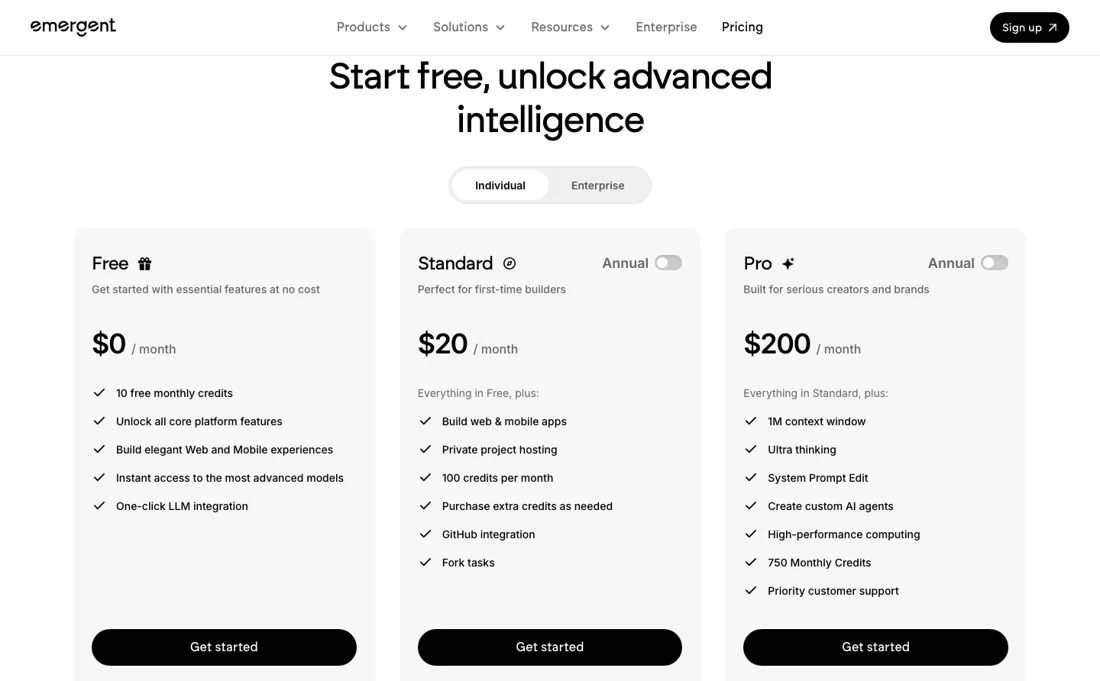
The real cost is credit consumption, not the flat sticker -- Emergent's own guide says one prompt can cost from a handful of credits for a small UI tweak to hundreds for a full feature with tests, and a published app keeps drawing credits every month for its hosting tier, so serious builders run through a plan faster than the price list implies. Standard is $20 for 100 credits, so 20 cents a credit.
Pro is $200 for 750, which is 26.7 cents. Moving up a tier makes every unit of work more expensive, not less: Pro costs 33% more per credit than Standard, and annual billing keeps the gap (17 cents against 22.3). That is the opposite of the volume discount the ladder looks like -- you are buying a 1M-token context window, custom agents and priority support, not cheaper work. Above Pro there is no bigger self-serve plan: Business and Enterprise are both quote-only.
Top-up packs fill the gap at the Standard rate, 250 credits for $50 or 20 cents a credit, but they are non-refundable. Check what your month actually needs before you upgrade; one Standard month plus purchased extra credits may beat one Pro month. AI-generated code still needs a human eye: review it for security, correctness and maintainability before anything touches real users.
Watch the video review
The video version of this review, from our YouTube channel.
⚡ Short on time? Watch the 30-second verdict Short.
What Emergent does
AI app builder. Describe what you want and Emergent builds full-stack web apps for you — an agentic, credit-based platform that turns prompts into working software with no manual coding.

What buyers report about Emergent
Hands-on: tested 2026-09-26Documented by the vendor: 1 feature, read 2026-10-09Reported by buyers: Trustpilot and app-builder comparisons, read August 2026
Themes from the buyer-review sites listed at the foot of this page, read in August 2026. We tested Emergent ourselves on 2026-09-26, but one test is a narrow sample, so here is what other buyers report. We summarise it here because the complaints are usually the part a vendor page leaves out.
- • It is genuinely fast at turning a prompt into a working full-stack app, and reviewers who got a result say nothing else matched it for speed.
- • Backed by a $70M Series B at a $300M valuation in January 2026, so it is not a weekend project.
- • Credits vanish in debugging loops. When the AI gets stuck fixing its own mistake it keeps spending on every failed attempt — one reviewer's 110 credits did not last a day, another burned through a plan fixing AI-generated errors and ended with no working app. Watch the counter, and stop it yourself when it loops.
- • Unused credits expire at the end of each billing period. There is no bank.
- • Complex apps hit context limits and freeze mid-task, and fixing one bug can break a feature that worked.
- • Free 10 credits, Standard $20 for 100, Pro $200 for 750; above Pro the ladder is quote-only, with Business and Enterprise both priced 'Custom' (pricing page re-read 31 August 2026).
Where the ratings disagree. Trustpilot sits around 2.7 with reviews heavily split — people either ship something impressive or burn a month's credits on nothing. That is not a middling product, it is a high-variance one, and the variance is in how well the first prompt lands.
Pages read (August 2026): Trustpilot
When the paid plan is worth it
This ladder runs backwards, and it is worth checking the arithmetic yourself before upgrading. Standard is $20 a month for 100 credits, which is 20 cents a credit. Pro is $200 for 750, which is 26.7 cents -- a third MORE per credit than the tier below it. Annual billing keeps the gap rather than closing it: $17 against $167 works out at 17 cents a credit versus 22.3. So Standard is the cheapest credit on the menu and Pro is the dearest; you are paying a premium to buy in bulk rather than getting a discount for it.
That makes the reason to move up something other than price. Pro adds a 1M-token context window, ultra thinking, system-prompt editing, custom agents and priority support -- capabilities rather than cheaper work, and that is the case you have to make for it, because on credits alone it does not stand up. What upgrading does not solve is the credit ceiling itself. Above Pro there is no published tier to climb to: Business and Enterprise are both quoted, so the moment 750 credits a month is not enough you are in a sales conversation rather than picking a bigger plan.
Extra credits can be bought as needed on Standard and above, which is the real release valve. Count the work you actually plan before choosing a tier.
Our monthly capture read this vendor's pricing page in September 2026 and again in October 2026, and the amounts were the same both times, including $36, $167, $200 and $396 from the pricing above. We keep watching — the registry records what moves.
What we found running Emergent ourselves
The first findings are at the top of this page. The rest:
- On the free plan the app could not be published: 'Deploy Your App' opens the plan chooser (a $1 seven-day Standard trial, then $20 a month). The two repairs used 19.17 credits, from 34.66 to 15.49.
Mail in the first 14 days
Mail timeline: not measured.
What this test does not show: One run on one day, tested on the preview because publishing needs a paid plan, so whether data survives a redeploy could not be checked. Not a security audit or a load test.
Most of our reviews are researched rather than run — how we review explains which is which, and why we do not pretend otherwise.
Try this before you buy
Build a class-booking app and try to break it. A one-person yoga studio takes class bookings. Visitors book, move or cancel; only the owner sees and cancels all bookings and exports them.
Anyone deciding between AI app builders for a small booking, sign-up or reservation app: whether the builder handles capacity, double bookings, a protected admin page, export and data that survives republishing.
We ran 16 of 18 checks on Emergent (Free, Web app) on 2026-09-26, with 2 repair rounds. Not run: T16, T18. One run on one day; re-run the checks on the plan you would buy.
- T01 App published. Loads at a public URL without logging in to the builder. Our run: failed.
- T05 Full is full. Ten simultaneous booking requests on an empty 8-spot class: 8 accepted, 2 refused. One manual double click is not this test; use simultaneous-bookings.js. Our run: failed in the first version, passed after repair.
- T11 Password not exposed. The admin password is not in the page source, the JavaScript or any URL. Our run: failed in the first version, passed after repair.
- T16 Data survives. Bookings are still there after a reload and after republishing. Our run: not tested.
- T18 Take it with you. Export the code (GitHub or zip) and the data; try to run it outside the builder and note what does not come along. Our run: not tested.
The kit has the prompt, all 18 checks with their pass conditions, made-up test data and our own run on Emergent, Lovable and Replit. No sign-up needed.
When our recommendation changes
- The app must be public at its own URL: On the free plan Emergent could not deploy, only show a preview (T01, 26 September 2026), so T16 and T18 could not be run; budget for a paid plan before you rely on it.
- Bookings or sign-ups must hold under load: The first version and the first repair both accepted 10 of 10 simultaneous bookings for 8 spots; the second repair fixed it. Run T05 with the script in the kit.
Not a security audit beyond T09 and T11, no load test beyond ten requests, no payments, email or real traffic, and one run per builder. The full test, check by check.
Questions we are still checking
Facts about Emergent that would change a buying decision, and where we stand on each. An unanswered question does not mean the feature is missing; it means we have not confirmed it yet.
- How many credits does a typical task use? Still checking
Applies to: all plans.
Why it matters: credits are the real meter, and the pricing page does not say what a task costs in credits.
Checked: Emergent pricing page (2026-08-31); Emergent llms.txt (points to the same pricing page) (2026-08-31)
Have a public source that answers one of these? How we review explains how we check and correct.
How to actually use Emergent
Start on Standard and measure before you climb, because the ladder works against you. Standard is 20 cents a credit and Pro is 26.7 -- moving up makes every unit of work more expensive rather than less. Spend a month on Standard's 100 credits and record what your actual changes cost: simple edits run 1 to 2 credits, medium features 5 to 10, complex refactors 10 to 20 and beyond.
Then do the division the pricing page does not. If your month needs 150 credits, check whether one Standard month plus purchased extra credits beats one Pro month before you upgrade -- you are buying context window, custom agents and support at the higher tier, not cheaper work. Scope your prompts to the credit bands. A request phrased as one complex refactor costs 10 to 20 credits; the same work split into three medium changes you can check between is 15 to 30 but fails cheaper when it goes wrong.
Early on, while you are learning how this model interprets your codebase, smaller steps waste fewer credits. And review everything before it touches real users. This is an excellent way to get from a prompt to a working prototype or MVP quickly, and it is not a hands-off factory for production software. Read the generated code for security, correctness and maintainability, and budget that reading time as part of the cost.
Where this section comes from: our research notes (170 words)
Vendor pricing page https://emergent.sh/pricing (read 2026-08-31 from a European exit -- the Individual tab gives Free, Standard and Pro with both monthly and annual rates and the stated $36 and $396 annual savings; the Enterprise tab gives Business and Enterprise, both priced 'Custom' behind Book a demo, with their feature lists). Vendor link index https://emergent.sh/llms.txt (read 2026-08-31), which points to the same pricing page as the source for plans and credit costs.
The per-task credit bands (1-2 / 5-10 / 10-20+) are carried over from earlier research and are not stated on either of those pages. Re-read 17 October 2026: the pricing page (monthly view, amounts unchanged) and the help pages help.emergent.sh/managing-credit-usage (credit types and rollover, top-up packs from 250 credits for $50 to 10,000+ for $2,000, publishing tier fees, Universal LLM Key, no overage billing, negative balance at renewal) and help.emergent.sh/cancellation-refunds (prorated refund of unused subscription credits minus published-app usage, top-ups non-refundable).
The guide's own range per prompt replaces the older per-task credit bands, which we no longer quote.
Emergent vs Lovable, side by side
Each column shows the vendor’s own published entry price, read on the date shown. Entry prices can cover different services or units, so check what each one buys. We do not average them into a score.
Both names above are affiliate links: we may earn a commission if you sign up, at no extra cost to you. Neither changes what this table says.
The natural comparison is Lovable, Bolt or Replit Agent — close AI app-builder rivals — compare credit economics and output quality on the kind of app you actually build.
Frequently asked questions
Can I publish an app on the free plan?
No. In our build on 26 September 2026, 'Deploy Your App' opened the plan chooser: a $1 seven-day Standard trial, then $20 a month. Standard is $20 a month, or $17 billed annually, for 100 credits; Free has 10 credits a month (pricing read 31 August 2026).
How quickly do credits go?
In our 26 September 2026 build, two repair prompts on a small booking app took the balance from 34.66 to 15.49 credits, 19.17 in total. Emergent does not publish a per-task cost on its pricing page, so budget from your own first sessions.
Does it protect existing data when it fixes a bug?
Not in our test. On 26 September 2026 both repair rounds cleared every booking in the app while removing test data, and the first also removed the database index its own capacity fix depended on, so overbooking returned until a second repair added a lock. Keep a copy of real data before asking it to repair anything.
What do I get back if I cancel a paid plan?
Emergent's help page on cancellation and refunds (read 17 October 2026) says you keep access until the end of the billing cycle and can get a prorated refund of the subscription credits you have not used, minus what your published apps consumed. Top-up credit packs are not refundable. A published app only stays live while your credits cover its monthly tier fee, so cancelling can take an app offline once the balance runs out.
Is this a hands-on review of Emergent?
Yes. We tested Emergent ourselves on 2026-09-26; the section above says what we tested, what we found and what we did not test, and where a figure comes from the vendor's own documentation instead. Most of our reviews are researched rather than run; we say which is which. We name what each tool is good and bad at, and we earn a commission only if you sign up, at no cost to you.
- Buyer reviews on Trustpilot and app-builder comparisons, read August 2026.
- Re-verified 2026-10-17 on emergent.sh/pricing in the monthly view, with the annual rates from the same page read on 16 October 2026, and on Emergent's help pages on managing credit usage and on cancellation and refunds.
- A dated screenshot of that pricing page, kept on this site as the receipt.
- Our own hands-on session with Emergent (2026-09-26), written up in full further down this page.
Others in this category
Reviewed it & productivity tools that share ground with Emergent — comparable in what they do, not drop-in swaps:
New reviews, price changes we recorded, and the cost conditions we found. No sponsored placements. Unsubscribe anytime.
This is our researched assessment — not a paid placement. The “Visit” links on this page are affiliate links: we may earn a commission if you sign up, at no extra cost to you, and it never changes our take. How we review →