Inbox Zero Review (2026)Open-Source AI Email Assistant From $18
 By Daan Haket · Researched and written with an AI assistant · who does what
There is no free plan: the trial needs a card and converts unless you cancel, though the site leads with 'Get started free'.
busy founders, executives and small teams on Gmail or Outlook who want their inbox sorted, replies drafted and newsletters cleared by AI, and who like that the code is open source and can be self-hosted.
you are not allowed to send email content to third-party AI providers and cannot self-host, you use an email provider other than Google or Microsoft, or you want one flat price for many mailboxes.
Transparency: the “Visit” links on this page are affiliate links — we may earn a commission if you sign up, at no extra cost to you. No vendor can pay for a better review or verdict. How we make money →
Pricing (2026)
✓ Pricing re-verified 15 Oct 2026
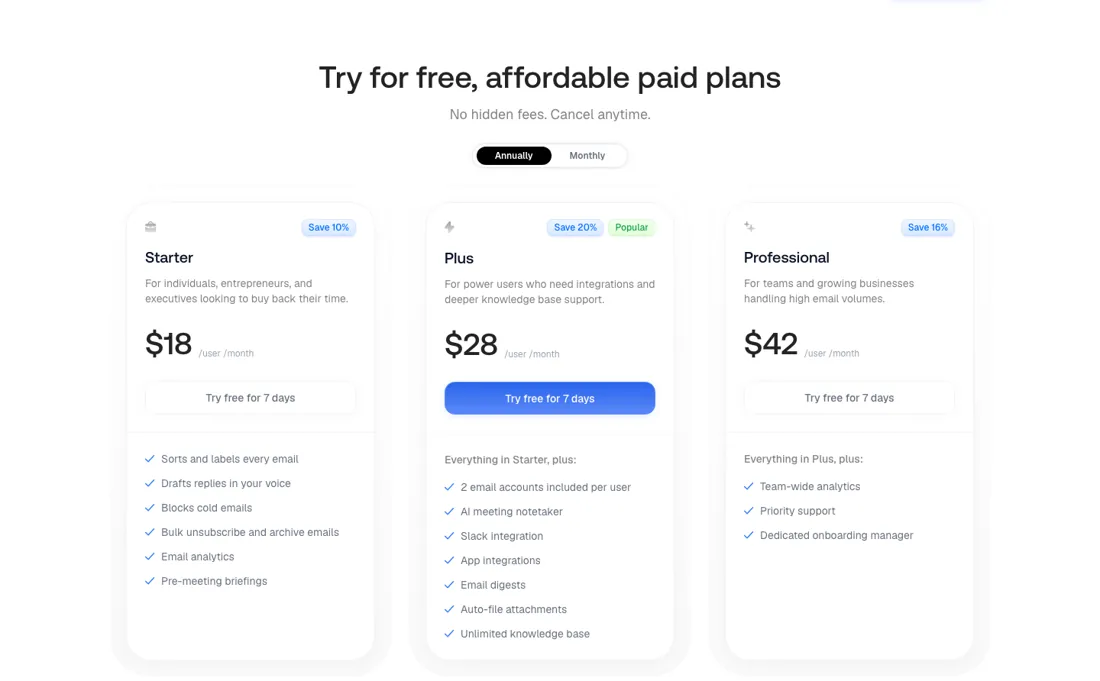
Three plans priced per user, plus Enterprise. Starter is $18 per user a month billed annually or $20 monthly: labelling and sorting every email, drafted replies in your voice, a cold-email blocker, bulk unsubscribe and archive, email analytics, pre-meeting briefings and a limited knowledge base. Plus is $28 annually or $35 monthly: two email accounts per user, an AI meeting notetaker, Slack and app integrations such as Notion and Stripe, email digests, auto-filing of attachments and an unlimited knowledge base.
Professional is $42 annually or $50 monthly: team-wide analytics, priority support and a dedicated onboarding manager. Enterprise, with SSO, SCIM and on-premise deployment, is priced by sales. Every plan has a 7-day free trial; the home page FAQ says a credit card is required and you are charged when the trial ends unless you cancel. Plan changes are prorated, cancellation keeps the plan to the end of the billing period, and the FAQ offers a refund if you email within 14 days of upgrading and feel you did not get value.
Students, nonprofits and open-source projects can ask for a discount by email. It works with Gmail, Google Workspace and Microsoft Outlook. Plans change — always verify the live price on their site.
Category context: IT & Productivity. Across the 36 tools in this category that we researched with a public US-dollar price, the median entry price is about $15 a month (lowest paid plan as listed, per seat where the vendor prices per seat). Inbox Zero’s entry price of $18 a month sits above that median. Compare pricing conditions in the Software Cost Atlas →
What the pricing page doesn’t say
Pricing is per user, and a second mailbox needs Plus. The terms of service date from July 2023, are short, name no company and say nothing about refunds; the refund promise lives only in the pricing FAQ, within 14 days of upgrading and at the vendor's judgement of value. The service reads your whole mailbox and passes email content to third-party AI providers. Security and popularity claims (SOC 2 Type 2, GitHub stars) are the vendor's own. We have not used Inbox Zero ourselves.
What Inbox Zero does
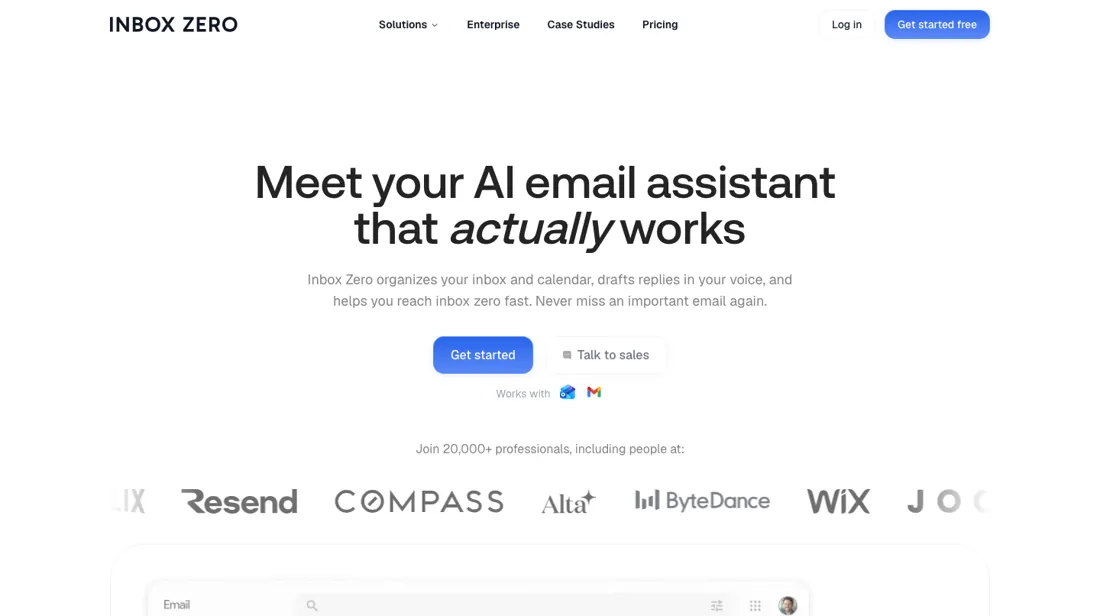
Open-source AI email assistant for Gmail and Outlook that labels incoming mail, drafts replies in your voice, blocks cold email and bulk-unsubscribes; can also be self-hosted.
Plus is where the second inbox lives
Starter already does the core job: it sorts and labels every email, drafts replies in your voice, blocks cold outreach and clears out newsletters. For one person with one mailbox that is the whole product, at $18 a month on a yearly plan or $20 month to month. Plus at $28 a year-rate is about connections. It is the first plan with two email accounts per user, the meeting notetaker, Slack and app integrations and an unlimited knowledge base, which matters if you want drafts that quote your own documents.
If you run a work and a personal inbox, Plus is the cheaper way to cover both than two Starter seats. Professional at $42 adds team analytics, priority support and an onboarding manager; it only earns its place for a team that wants to see email load across people. Because pricing is per user, a team of five on Plus is $140 a month billed annually, our arithmetic.
How to actually use Inbox Zero
Start the 7-day trial with the mailbox that hurts most, and note the date: a card is required and billing starts when the trial ends unless you cancel. Connecting is a Google or Microsoft sign-in that gives Inbox Zero access to your mail, so read the privacy policy first; it says email content goes to third-party AI providers to sort and draft, and that those providers may not train on it.
In the first days, let it label and draft rather than act. Check the labels it puts on a few dozen emails and correct the rules in plain language before letting it archive or reply on its own. Run the bulk unsubscribe once; it is the quickest visible win. If you would rather keep mail data on your own servers, the code is open source and the home page says you can self-host it, at the cost of running and updating it yourself.
Where this section comes from: our research notes (107 words)
Inbox Zero's own pages, read in a live browser on 15 October 2026: the pricing page at getinboxzero.com/pricing with its plan comparison table and FAQ (trial, plan changes, annual discount, refunds), the home page with its FAQ (supported providers, credit card for the trial, open-source code), the terms of service dated 16 July 2023 (New York law and courts) and the privacy policy (Inbox Zero Inc., Newark, Delaware; third-party AI models; Google API Limited Use).
The SOC 2 Type 2, GitHub star and trending claims are the vendor's own. Inbox Zero is an affiliate partner of ours through Lemon Squeezy. We have not used Inbox Zero ourselves.
Inbox Zero vs SaneBox, side by side
Each column shows the vendor’s own published entry price, read on the date shown. Entry prices can cover different services or units, so check what each one buys. We do not average them into a score.
Both names above are affiliate links: we may earn a commission if you sign up, at no extra cost to you. Neither changes what this table says.
The natural comparison is SaneBox — SaneBox is in our dossiers too, re-verified on 24 September 2026: from $9.49 a month month to month, $5.42 on an annual plan or $4.54 on a two-year plan for one account, and it filters mail into folders without writing anything. Inbox Zero, read on 15 October 2026, is $20 a month or $18 billed annually per user, and adds AI-drafted replies, meeting briefings and a cold-email blocker. SaneBox is the cheaper, quieter filter; Inbox Zero is the AI assistant that also writes..
Frequently asked questions
How much does Inbox Zero cost?
Read on 15 October 2026, per user per month: Starter $18 billed annually or $20 monthly, Plus $28 or $35, Professional $42 or $50. Enterprise is quoted. Every plan starts with a 7-day trial that needs a credit card.
Is Inbox Zero free?
Not as a hosted service: there is no free plan, only a 7-day trial that converts to paid unless you cancel. The code is open source, and the home page says you can self-host Inbox Zero, which costs nothing in licence fees but means running it yourself.
Does Inbox Zero send my email to an AI company?
Yes, to provide sorting and drafting. Its privacy policy, read 15 October 2026, says it uses third-party AI services, that those providers may use the data only to deliver the service and may not train on it, and that email content is not kept beyond what a feature needs. Its use of Google data follows Google's Limited Use rules.
Is this a hands-on review of Inbox Zero?
This is a researched assessment, not a hands-on test — where we've used a tool ourselves, we say so explicitly. We name what each tool is good and bad at, and we earn a commission only if you sign up, at no cost to you.
- Read 2026-10-15 in a live browser on getinboxzero.com/pricing with its comparison table and FAQ, the home page, the terms of service dated 16 July 2023 and the privacy policy.
- A dated screenshot of that pricing page, kept on this site as the receipt.
Others in this category
Reviewed it & productivity tools that share ground with Inbox Zero — comparable in what they do, not drop-in swaps:
New reviews, price changes we recorded, and the cost conditions we found. No sponsored placements. Unsubscribe anytime.
This is our researched assessment — not a paid placement. The “Visit” links on this page are affiliate links: we may earn a commission if you sign up, at no extra cost to you, and it never changes our take. How we review →